Being struck by a vehicle while walking is a life-altering event. Pedestrian accidents almost invariably result in severe injuries because the human body has no protection against the force and weight of a vehicle.
Once the immediate crisis has passed, and you or your loved one are beginning the long road to recovery, the most pressing questions are: "How long will it take to get justice, and when will I receive the compensation needed to cover these medical bills?"
The simple answer is that there is no fixed timeline. Pedestrian accident claims are complex and can take anywhere from 6 months to 2 years (or more) to reach a resolution, depending on several critical factors.
At DFW Injury Lawyers, we understand the financial pressure you are under. We prioritize securing the maximum possible compensation, but we also know that rushing a claim often means sacrificing value.
Our comprehensive guide breaks down the typical timeline, the stages of the legal process, and the variables that specifically influence the duration of a pedestrian accident claim in Texas.
Contact us today at (972) 440-2320 to speak with an experienced pedestrian accident lawyer and receive a free case evaluation.
Key Takeaways: Pedestrian Accident Claim Timeline
- No Quick Fix: Pedestrian accident claims rarely settle quickly due to the severity of the injuries involved. The timeline typically ranges from 6 months to over 2 years.
- Maximum Medical Improvement (MMI) is the Key: The biggest factor influencing the timeline is reaching MMI, the point where your medical condition stabilizes. You must not settle before MMI is reached, as future medical costs and long-term impairment cannot be accurately calculated beforehand.
- The Three Stages: The process moves from Foundation (medical care, investigation, evidence collection), to Demand & Negotiation (settlement package compilation and back-and-forth), and finally to Litigation if applicable (lawsuit, discovery, and trial/mediation).
- Liability and Coverage Complicate: Claims take longer if liability is disputed (requiring accident reconstruction) or if the at-fault driver has inadequate insurance (requiring pursuit of UM/UIM or third-party liability like Dram Shop claims).
- Do Not Rush: Rushing a settlement before MMI is complete means accepting a significantly lower value, often failing to cover the true lifetime cost of catastrophic injuries. Patience is essential for maximizing compensation.
Phase 1: The Critical Foundation (The First 1-3 Months)
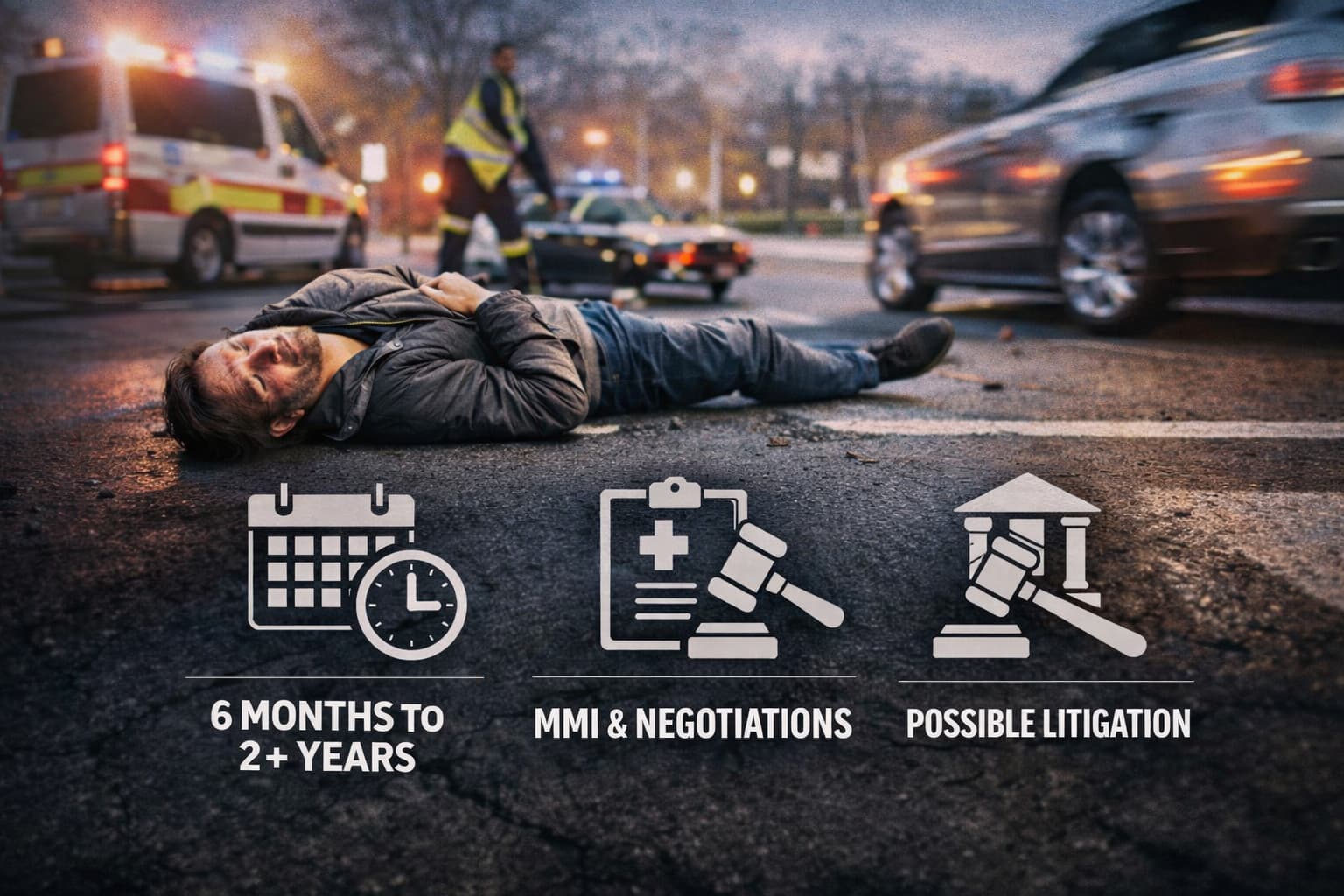
The first few months following a pedestrian accident are crucial. During this time, the primary focus is not on negotiation, but on securing your health and building an undeniable legal foundation.
Step 1: Immediate Medical Care and Diagnosis
The clock on your legal claim essentially starts ticking the moment you begin receiving treatment. Unlike car accidents where the injury severity may be debated, pedestrian injuries are usually immediate and severe (e.g., fractured limbs, severe head trauma, internal bleeding).
- Duration: Immediate, ongoing.
- The Key Goal: Establish a clear, undeniable causal link between the crash and your injuries, documented through emergency room reports, diagnostic imaging, and specialist consultations.
Step 2: Maximum Medical Improvement (MMI)
This is the single biggest factor influencing the timeline. Before an attorney can accurately calculate the final value of your claim, your medical condition must stabilize. This stage, known as Maximum Medical Improvement (MMI), is reached when:
- You have completed all necessary surgeries and acute rehabilitation.
- Your doctors determine that your condition is unlikely to improve significantly further, or that you have reached the point where only chronic management or long-term care is needed.
- A physician can issue a permanent impairment rating to quantify your long-term disability.
The more severe the injury, the longer the MMI period will be, often extending the claim timeline. A simple, quickly healed fracture might reach MMI in 3-6 months while a spinal injury may take longer.
Step 3: Investigation and Evidence Collection
Our team conducts a thorough, independent investigation. We do not rely solely on the police report.
- Securing Footage: We immediately issue spoliation letters to preserve traffic light camera footage, nearby business security video, and dashcam recordings.
- Witness Interviews: We track down and interview witnesses whose contact information may not have been included in the police report.
- Accident Reconstruction: In cases involving disputed liability, we may retain an accident reconstructionist to analyze vehicle speed, braking distance, and impact dynamics.
Phase 2: Demand and Negotiation (Months 3-9, Post-MMI)
Once MMI is reached, all necessary evidence is gathered, and the full scope of past and future damages is known, your attorney can move to the formal demand phase.
Step 4: Compiling the Settlement Demand Package
This detailed document is the core of your claim. It is meticulously compiled to demonstrate the negligence of the driver and the full monetary value of your losses. The package includes:
- Liability Argument: A legal brief proving the driver's fault (e.g., distracted driving, speeding, failure to yield).
- Full Medical Records: All bills, reports, and the MMI/permanent impairment rating report.
- Economic Loss Summary: Documentation of lost wages, lost future earning capacity, and the costs of future care (often prepared by an economist or life care planner).
- Demand Amount: The calculated total compensation figure, including both economic damages and non-economic damages (pain and suffering, mental anguish).
Step 5: The Negotiation Process
Once the demand is sent to the at-fault driver's insurance company (typically after MMI is reached), the formal negotiation process begins.
- Initial Response (2-4 weeks): The insurer will assign an adjuster and defense attorney. They will review the package and often respond with a low initial offer, or a denial, claiming the pedestrian was at fault (leveraging Texas's modified comparative negligence law).
- Back-and-Forth Negotiations (1-4 months): Your attorney will strategically counter, using the strength of the evidence (police reports, video, MMI reports) to force the insurance company to increase their settlement offer.
- Mediation: If negotiations stall, the parties may agree to attend mediation, a voluntary, non-binding session where a neutral third-party mediator works to facilitate a settlement. Mediation can often resolve a claim quickly and efficiently, bypassing the need for a full trial.
Mediation is often the most cost-effective and fastest way to resolve a pedestrian accident claim without going to trial. A neutral, trained mediator guides the parties toward a middle ground, sometimes resulting in a settlement agreement in a single day.
Phase 3: Litigation (Lawsuit Filing to Resolution: 12-24+ Months)
If negotiations fail or the insurance company refuses to offer fair compensation that reflects the severity of your injuries, your attorney will recommend filing a formal lawsuit in the appropriate Texas court.
Step 6: Filing the Lawsuit and Discovery
The filing of the lawsuit begins the formal litigation process.
- Pleadings (1 Month): Your attorney files the Petition, and the defendant (the driver and/or their employer) files an Answer.
- Discovery (6-12 Months): This is the extensive information-gathering phase. Both sides exchange written questions (Interrogatories), requests for documents (Requests for Production), and requests for admissions.
- Depositions (3-6 Months): Key individuals, the victim, the driver, police officers, and expert witnesses (doctors, reconstructionists), are required to give sworn testimony outside of court. Depositions are crucial for locking in testimony and exposing weaknesses in the defense's case.
Step 7: Pre-Trial Motions and Final Mediation
As the case approaches the trial date, motions are filed to exclude evidence or dismiss parts of the claim. Often, a second, mandatory mediation session is required by the court.
- Mandatory Mediation: Even after over a year of litigation, over 95% of personal injury cases in Texas settle before a jury is seated. This final mediation provides one last chance to resolve the case without the risk and expense of a full trial.
Step 8: Trial (Jury Verdict)
If all negotiation efforts fail, the case proceeds to trial.
- Duration: A pedestrian accident trial involving catastrophic injuries can last 4 days to 2 weeks (or more).
- Post-Trial Appeals: Even after a favorable jury verdict, the defendant may file an appeal, which can add another 6 months to 1 year to the final resolution time.
Key Variables That Extend or Shorten the Timeline
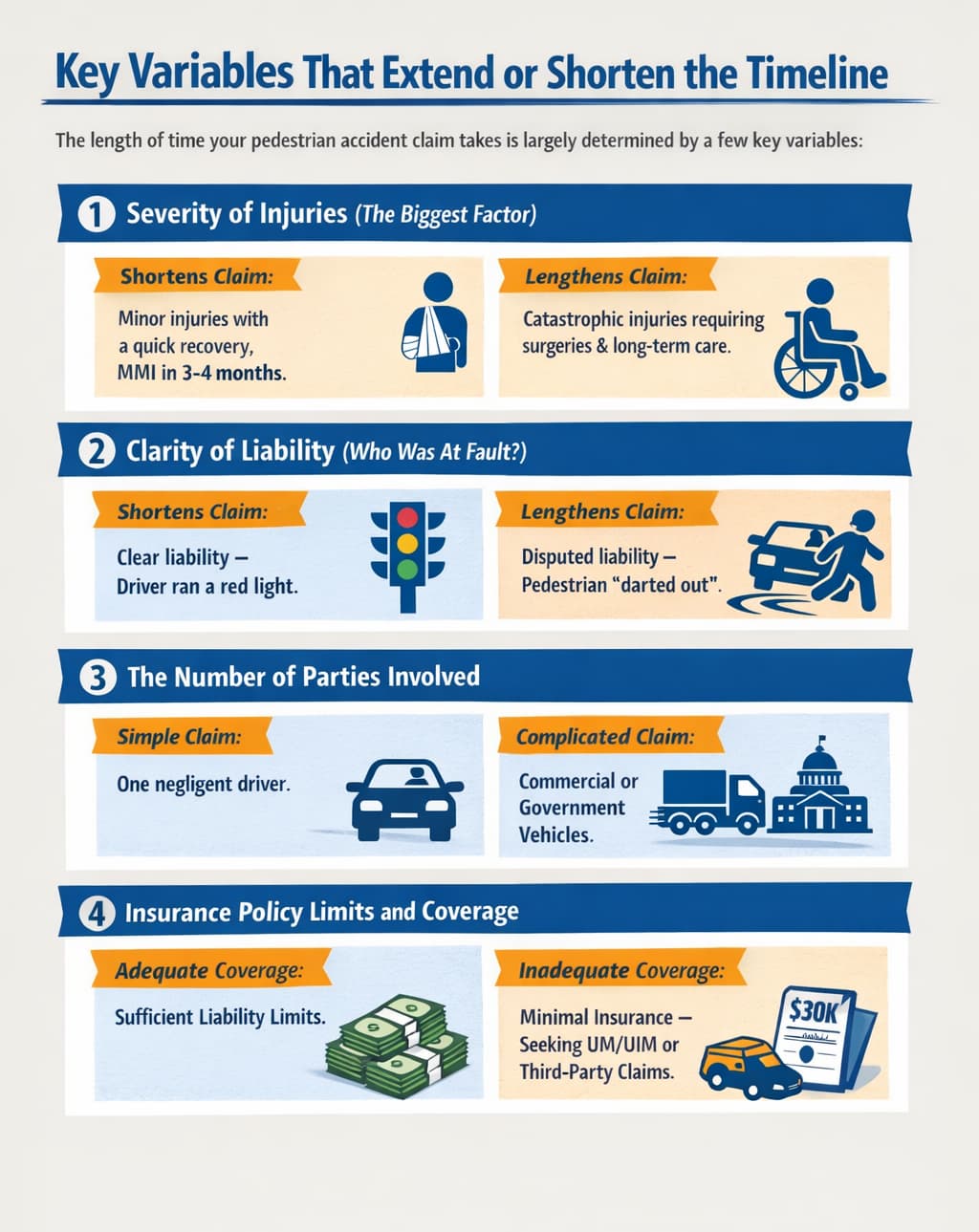
The length of time your pedestrian accident claim takes is largely determined by a few key variables:
1. Severity of Injuries (The Biggest Factor)
- Shortens Claim: Minor injuries with a quick recovery, allowing MMI to be reached in 3-4 months.
- Lengthens Claim: Catastrophic injuries requiring prolonged rehabilitation, surgeries, and future medical projections.
2. Clarity of Liability (Who Was At Fault?)
- Shortens Claim: Clear liability where the driver ran a red light and the police report confirms it. The insurer cannot reasonably dispute fault.
- Lengthens Claim: Disputed liability where the driver claims the pedestrian "darted out" or was outside the crosswalk. This requires extensive accident reconstruction and can force the case into litigation.
3. The Number of Parties Involved
- Simple Claim: One negligent driver with high insurance limits.
- Complicated Claim: A commercial vehicle hits you (bringing in the trucking company and corporate liability) or a government vehicle hits you (involving the strict Texas Tort Claims Act and its short notice periods). Adding defendants increases investigation time and negotiation complexity.
4. Insurance Policy Limits and Coverage
- Adequate Coverage: When the driver has sufficient liability limits to cover your total damages, a settlement is easier to reach because the insurance company has the funds available.
- Inadequate Coverage: If your $1,000,000 injury is caused by a driver with only $30,000 in liability insurance, your attorney must then pursue alternative recovery sources:
- Your own Uninsured/Underinsured Motorist (UM/UIM) coverage.
- A claim against a third party (e.g., the bar that overserved the driver under Dram Shop liability). This pursuit may add time to your case.
Why Choose Us for Your Pedestrian Accident Claim
When you have suffered a catastrophic injury as a pedestrian, your legal representation needs to be as aggressive and thorough as the defense you will face. DFW Injury Lawyers is a dedicated firm built to handle the most difficult and high-value personal injury cases in Texas.
1. Experience in Catastrophic Injury Valuation
We don't guess at your future needs. Our firm has established relationships with leading medical and financial experts, including life care planners and economists, who accurately project the full, lifetime cost of your injury.
We ensure your demand reflects not just your past bills, but decades of future care, lost earning capacity, and the true value of your pain and suffering.
2. Immediate, Advanced Evidence Capture
The time-sensitive evidence required for pedestrian cases often disappears quickly. We move immediately to issue spoliation letters and hire professional investigators. We control the facts of the case from day one, eliminating the defense's ability to shift blame onto you.
3. Trial Readiness is Our Leverage
Our reputation for trial readiness is some of the most significant leverage we possess, forcing insurance companies to offer maximum value during pre-trial negotiation and mediation. This can lead to a higher settlement amount faster than firms the insurance companies don't fear.
4. Navigating Liability & Coverage
Whether your accident involves a commercial vehicle, a city bus (requiring knowledge of the Texas Tort Claims Act), or an uninsured motorist, we have the knowledge to pursue all possible avenues of compensation, including leveraging your own UM/UIM policy or filing Dram Shop lawsuits.
Why You Should Not Rush Your Claim
While it is tempting to seek a quick settlement to cover immediate bills, rushing the process is almost always a mistake that benefits only the insurance company.
- Incomplete Damages: If you settle before reaching MMI, you are settling for an unknown amount of future medical care. If you need unexpected surgery six months later, you cannot go back and ask for more money.
- No Future Earning Loss: Without a permanent impairment rating (only achievable at MMI), you cannot fully quantify the reduction in your future earning potential, potentially leaving hundreds of thousands of dollars on the table.
- Loss of Leverage: An attorney who demonstrates patience and a willingness to fully investigate and litigate signals to the insurer that they must pay, leading to a higher final settlement.
At DFW Injury Lawyers, our commitment is to our clients. We front the time, expense, and investigation required, allowing you to focus completely on your physical and emotional recovery. We will advise you on the quickest possible route, but we will never compromise the value of your case just to close the file fast.
Start Protecting Your Claim Today
If you or a loved one has been seriously injured as a pedestrian in Dallas, Fort Worth, or anywhere in the surrounding areas, the clock is running, and the challenges of the claim are only growing.
Let us handle the insurance companies, the investigation, and the litigation process while you focus on healing. Contact our seasoned personal injury lawyer today for a free, confidential case evaluation.
Call us now at (972) 440-2320 to learn how long your specific claim might take and how we can best position it for success.

Pedro “Peter” de la Cerda
Founder
Attorney Pedro “Peter” de la Cerda is a co-founder of DFW Injury Lawyers. As a young attorney looking for courtroom experience, Mr. de la Cerda began his career defending physicians, nurses, hospitals, trucking, and manufacturing companies in disputes involving personal injury, medical malpractice, products liability, and toxic tort. After seeing many people who were truly injured and deserving of fair compensation, however, Mr. de la Cerda was moved to cross the courtroom aisle and prosecute cases on behalf of plaintiffs in personal injury cases.
Author's Bio