The driver who is at fault in a T-bone accident is usually the one who entered the intersection when Texas law required them to stop or yield. Which car hit which matters far less than which driver had the right-of-way at that moment. That distinction surprises many people.
A driver can T-bone another car and still be the one with the stronger claim, because the other driver pulled across their path.
Key Takeaways: T-Bone Accident Liability
- A driver facing a steady red light must stop and stay stopped until a signal allows them to proceed.
- A driver turning left must yield to oncoming vehicles that are in the intersection or close enough to be an immediate hazard.
- A driver at a stop sign who collides with a vehicle that had the right-of-way is presumed by statute not to have yielded.
- Texas uses proportionate responsibility, so you can’t recover compensation if you’re more than 50% responsible.
- Most Texas car accident injury lawsuits must be filed within two years of the crash.
Which driver is usually at fault in a Texas T-bone crash?
The driver who failed to yield the right-of-way is at fault for T-bone crashes. Common examples include a driver who ran a red light, rolled through a stop sign, or turned left into oncoming traffic. Both drivers can share fault.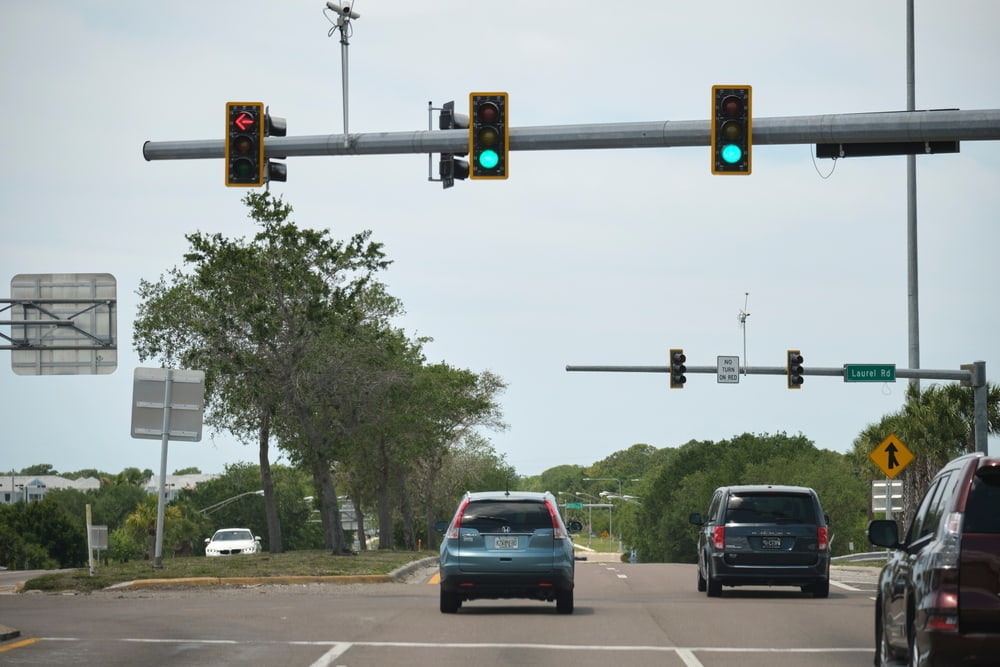
How Do Texas Right-of-Way Rules Decide Fault in a T-Bone Crash?
In a T-bone crash, fault usually follows the right-of-way rule that applies at that intersection. Insurers and juries start by asking what controlled the intersection, a signal, a stop or yield sign, or nothing at all, and which driver that control required to wait.
| Situation | Driver Who Usually Must Yield |
|---|---|
| Signal turns red | The driver facing the steady red light |
| Left turn on a green light | The driver turning left |
| Stop sign at a cross street | The driver at the stop sign, after stopping |
| Yield sign | The driver facing the yield sign |
| Intersection with no signs or signals | The driver on the left yields to the vehicle on the right |
| Pulling out of a driveway or parking lot | The driver entering the road |
These rules set the starting point, and the facts of each crash decide whether either driver also acted carelessly.
Who Is at Fault When a Driver Runs a Red Light?
The driver who ran the red light is usually at fault in a T-bone crash, because Texas requires a driver facing a steady red signal to stop and remain stopped. Red-light crashes often turn into disputes over who had the green, so video, witnesses, and signal timing evidence carry real weight.
Who Is at Fault in a Left-Turn T-Bone Crash?
A driver turning left at an intersection usually bears fault for a T-bone crash with an oncoming car. Section 545.152 requires a left-turning driver to yield to any vehicle approaching from the opposite direction that is in the intersection or close enough to be an immediate hazard.
A green light permits the turn but doesn’t remove the duty to wait for a safe gap.
Who Is at Fault at a Stop Sign or Yield Sign?
At a stop sign, the driver who had to stop is usually at fault if they pulled into the path of cross traffic. Section 545.151 says a driver required to stop and yield who then collides with a vehicle that had the right-of-way is presumed not to have yielded.
At a yield sign, Section 545.153 says that if a driver passes the sign without stopping and collides with a vehicle that had the right-of-way, the law treats the crash as evidence that the driver failed to yield.
Who Is at Fault at an Uncontrolled or T-Shaped Intersection?
At an intersection with no signs or signals, Texas law generally requires a driver to yield to a vehicle approaching from the right. Where one road ends at the intersection and forms a "T," the driver on the ending road must yield to traffic on the through road. Divided highways and paved-versus-unpaved crossings have their own yield rules in the same section.
Who Is at Fault When a Car Pulls Out of a Driveway?
A driver leaving a driveway, parking lot, alley, or private road usually bears fault for a side-impact crash with traffic already on the road. Section 545.155 requires the driver to yield to vehicles approaching on the highway being entered. These crashes are common outside shopping centers and gas stations along busy commercial roads.
Can Both Drivers Share Fault in a T-Bone Accident?
Both drivers can share fault in a Texas T-bone accident. Having the right-of-way doesn’t excuse speeding, texting, or ignoring a hazard the driver could have avoided, and insurers often argue that the driver who was hit should have seen the other car coming.
In Texas, your share of fault reduces how much compensation you can recover. If you're more than 50% at fault, you can't recover anything under Section 33.001.
Here’s how the math works in a T-bone case with $100,000 in total damages:
- 0% at fault: You can recover up to the full $100,000, subject to available insurance.
- 20% at fault: The recovery is reduced to $80,000.
- 50% at fault: The recovery is reduced to $50,000.
- 51% at fault: The injured driver recovers nothing.
Those percentages are why a few seconds of video or a single witness can change the value of a T-bone claim so much.
When a T-bone claim is disputed, the insurer for the driver who failed to yield often argues that the other driver could have avoided the crash. Common versions of that argument are that the driver was speeding through the intersection, was looking at a phone, entered on a late yellow, or was driving at night without headlights.
Each argument needs evidence, and each can be addressed with the same video, vehicle data, and witness accounts used to prove the other driver's fault.
Who Pays for Injuries After a Texas T-Bone Crash?
The at-fault driver's liability insurance pays for injuries in most Texas T-bone crashes, because Texas is an at-fault state. Texas requires drivers to carry at least $30,000 per injured person and $60,000 per crash in bodily injury liability under the state minimum coverage rules. Unfortunately, sometimes a serious side-impact crash can exceed those amounts.
Your Own Coverage Can Help Too
Your own insurance may help cover your losses while the fault is being decided. Personal Injury Protection (PIP) pays benefits regardless of who caused the crash and comes with Texas auto policies unless you reject it in writing. Uninsured/Underinsured Motorist (UM/UIM) coverage may also help if the driver who failed to yield has no insurance or not enough to cover your losses.
Your Deadline
Most Texas car accident injury lawsuits have a two-year filing deadline. Exceptions can change that period, and claims involving a government vehicle can require written notice much sooner, so the deadline is worth confirming early rather than assuming.

What Evidence Proves Fault in a Side-Impact Collision?
The evidence that proves fault in a side-impact collision is whatever shows who had the right-of-way and how each driver approached the intersection. Since T-bone crashes happen in a few seconds, physical and electronic evidence usually carries more weight than either driver's memory.
The evidence most often used in T-bone cases includes:
- The Texas Peace Officer's Crash Report (CR-3)
- Video from traffic cameras, nearby businesses, doorbell cameras, and dashcams
- Event data recorder information showing speed and braking before impact
- Statements from witnesses who saw the signal or the turn
- The location and depth of damage on each vehicle, which helps reconstruct the angle and speed
When a Commercial Truck Causes a T-Bone Crash
A T-bone crash caused by a commercial truck or delivery vehicle can involve the trucking company as well as the driver. Large trucks need more room to complete a turn or clear an intersection, so a truck that pulls across traffic without enough time can leave other drivers no way to avoid it.
These claims often require early requests for the truck's electronic data and the company's records before they are lost.
What Can You Do to Protect a T-Bone Accident Claim?
You can protect your T-bone accident claim by preserving evidence of who had the right-of-way, documenting your injuries, and being careful when dealing with the other driver's insurer.
Many claimants find it helpful to:
- Write down which direction each car was traveling and what the signal or sign showed, while the details are fresh.
- Note any business, home, or traffic camera that may have recorded the intersection.
- Keep the names and phone numbers of any witnesses.
- Get medical care promptly and keep every record and bill.
- Let a lawyer take over detailed questions from the other driver's insurer about fault.
Video is often overwritten within days or weeks, so acting early on that step can matter most.
FAQs: T-Bone Accident Fault in Texas
Does a traffic ticket decide who is at fault in a T-bone crash?
A citation is evidence that the insurer will consider, but it doesn’t settle civil liability for a T-bone accident in Texas. The injury claim looks at all the evidence, and a driver who was not cited can still be found partly at fault.
Can a passenger sue both drivers after a T-bone accident?
A passenger injured in a Texas T-bone crash can bring claims against either or both drivers, depending on who caused the collision. Fault is divided among the drivers, and the passenger is usually not assigned any share.
What if the driver who hit me was turning right on red?
A Texas driver can turn right on red only after stopping and yielding to other traffic lawfully using the intersection. A driver who turns right on red into your path fails to yield, unless you entered the intersection unlawfully.
Who has the right-of-way if the traffic light is out?
When a Texas traffic signal displays no light in any of its signal heads, drivers must stop and yield as they would at a stop sign. Drivers then proceed in turn when the intersection can be entered safely.
Can I still make a claim if the police didn’t come to the T-bone crash?
You can still bring a claim without a police report, but you will rely more on your own photos, witness information, and medical records. TxDOT advises drivers in crashes not investigated by an officer to keep their own records, since it no longer keeps driver-filed crash reports.
Getting Answers After a Side-Impact Crash

Fault in a T-bone crash is often decided in the first weeks, while the video still exists and witnesses still remember the signal. Bringing in a legal team early helps lock down that evidence before it’s gone, and puts someone in your corner before the insurer settles on its version of the crash.
Need a Texas car accident lawyer? Bring in the Muscle: call DFW Injury Lawyers at 888-231-1341 to talk through what happened.

Kevin L. Edwards
Founder
Attorney Kevin Edwards is a co-founder of DFW Injury lawyers. Over the last 15 years, Mr. Edwards has dedicated his practice to helping those who have been injured or harmed by the negligence, malfeasance, and/or recklessness of others.
Author's Bio