After a car crash, to successfully recover compensation for your injuries and damages, you’ll generally need to provide evidence that proves the other driver was at fault. This involves gathering a combination of official documents like police reports and physical proof from the scene, such as photos, and statements from anyone who saw the collision happen. Building a strong foundation of evidence is the key to demonstrating what truly occurred and holding the responsible party accountable.
Reach out to our Dallas car accident lawyer today to help gather evidence and prove fault so you can pursue the compensation you deserve.
Key Takeaways about the Evidence Needed to Prove Fault in a Dallas Car Accident
- Establishing fault is essential for a personal injury claim in Texas, which operates under a proportionate responsibility system.
- Evidence collected at the accident scene, including photographs, videos, and witness contact information, is often the most impactful.
- Official documents such as police reports and comprehensive medical records form the official backbone of a car accident claim.
- Advanced evidence, like data from a vehicle's "black box" or nearby surveillance footage, can offer objective insights into the crash.
- An injured person's own actions, such as what they say to insurers or post on social media, can also affect the claim's outcome.
- The determination of fault directly influences whether an individual can recover financial compensation and how much they may receive.
Understanding "Fault" in Texas Car Accidents
Before we dive into the types of evidence, it’s important to understand what "fault" means in the context of a Texas personal injury claim. Legally, it’s often referred to as negligence. In simple terms, negligence means that someone had a responsibility to act with reasonable care, they failed to do so, and their failure caused you harm.
For drivers on roads like the Dallas North Tollway or I-30, this responsibility (or "duty of care") includes obeying traffic laws, paying attention to the road, and not driving under the influence. If a driver breaches this duty by texting, speeding, or running a red light, and that action causes a crash that injures you, the driver is considered negligent.
Texas uses a legal rule called proportionate responsibility, sometimes known as modified comparative fault. This rule is outlined in the Texas Civil Practice and Remedies Code § 33.001. Here’s what it means for you:
- You can recover compensation from another party as long as you are found to be 50% or less at fault for the accident.
- Your final compensation amount will be reduced by your percentage of fault. For example, if you are awarded $100,000 but found to be 10% at fault, you would receive $90,000.
- If you are found to be 51% or more at fault, you are barred from recovering any compensation from the other driver.
This 51% bar is precisely why collecting strong, clear evidence is so critical. The other driver’s insurance company will look for any reason to shift more of the blame onto you to reduce or deny your claim. Having solid proof helps protect your right to fair compensation.
The Most Powerful Types of Evidence to Collect
The evidence you gather can be separated into a few main categories. Some of it you can collect yourself in the days following the crash, while other types may require professional assistance to uncover. Thinking through each of these areas can help you build the strongest possible case.
Evidence from the Scene of the Dallas Crash
The most compelling evidence often comes directly from the location of the collision, whether it was on a busy street in Oak Cliff or a highway near Arlington. If you were able to, or if someone could do it for you, collecting information right away is incredibly helpful.
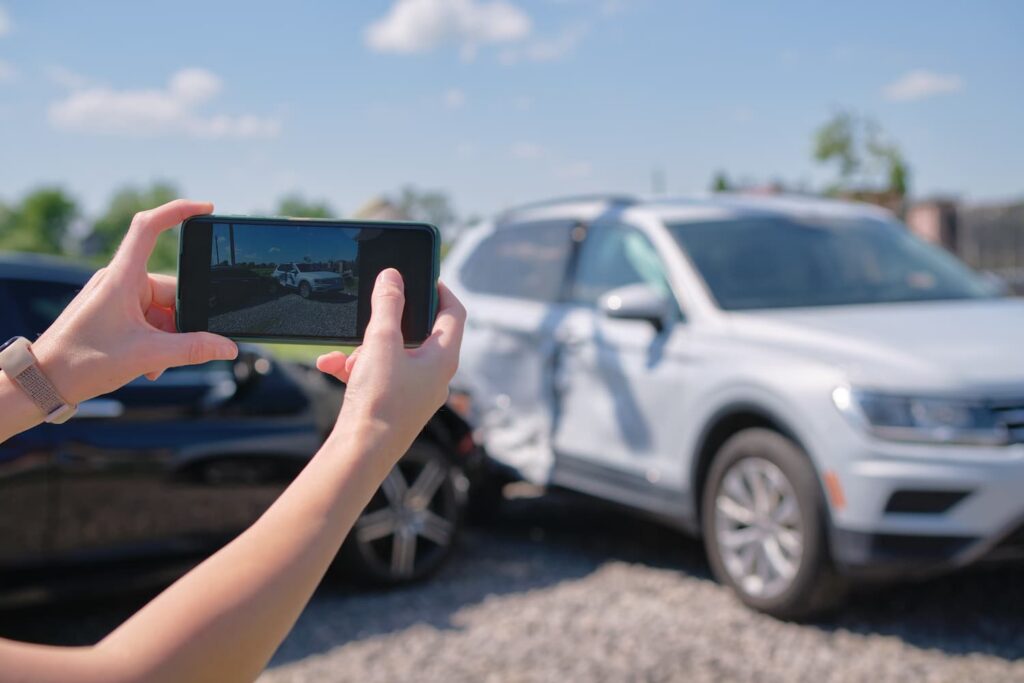
- Photographs and Videos: A picture is truly worth a thousand words. Use your smartphone to document everything you can. Capture photos and videos of all vehicles involved from multiple angles, showing the points of impact and the overall damage. Also, be sure to document the surrounding area, including skid marks, debris on the road, traffic signs or signals, and weather conditions.
- The Official Police Report: If police responded to the scene, they created an accident report. This report contains the officer's initial observations, a diagram of the crash, statements from drivers and witnesses, and sometimes the officer's opinion on who was at fault. You can typically request a copy of your Texas Peace Officer’s Crash Report (Form CR-3) from the police department that responded, such as the Dallas or Fort Worth Police Department, a few days after the incident. While not the final word, this report is a cornerstone of any claim.
- Witness Information: Independent witnesses who have no stake in the outcome can provide powerful, unbiased accounts of what happened. If anyone stopped to help or saw the crash, get their name and phone number. Their testimony can be invaluable in confirming your version of events.
Having this on-the-ground information creates a clear and immediate picture of the incident that is difficult for insurance companies to dispute.
Documentary Evidence for Your Car Accident Claim
While evidence from the scene tells the story of the crash, documentary evidence tells the story of its impact on your life. This paperwork is crucial for proving the financial and physical losses you have suffered.
Key documents to keep organized in a dedicated folder include:
- Medical Records and Bills: Every doctor’s visit, physical therapy session, prescription, and medical bill is a piece of the puzzle. These records, from providers like UT Southwestern Medical Center or Texas Health Presbyterian, create a direct link between the crash and the physical harm you endured. Be sure to follow all your doctor's treatment recommendations.
- Vehicle Repair Estimates: Get detailed estimates from reputable auto body shops to show the cost of repairing or replacing your vehicle. This helps establish the value of your property damage claim.
- Proof of Lost Wages: If your injuries kept you from working, you'll need to prove that lost income. This can be done with pay stubs, a letter from your employer confirming your rate of pay and missed time, or tax documents if you are self-employed.
These documents translate your experience into concrete figures that are used to calculate the compensation you may be entitled to receive.
Uncovering Advanced Evidence to Strengthen Your Case
Sometimes, the most persuasive evidence isn't something you can easily see or collect on your own. In complex cases, especially those involving commercial trucks or severe injuries, it may be necessary to dig deeper to truly prove fault in a Dallas car accident.
An experienced legal team can help access more technical forms of evidence. For instance, many modern vehicles are equipped with an Event Data Recorder (EDR), often called a "black box." This device records critical data in the seconds before and during a crash, such as vehicle speed, brake application, and steering angles. This data can provide an unbiased, second-by-second account of what happened.
Other forms of advanced evidence include:
- Surveillance Footage: Many businesses, traffic cameras, and even homes in areas like Garland and Lancaster have security cameras. Footage from a camera overlooking an intersection or a stretch of road could have captured the entire accident.
- Cell Phone Records: If you suspect the other driver was texting or talking on their phone, their cell phone records can sometimes be obtained through legal processes. These records can show phone activity at the exact time of the crash, providing strong proof of distracted driving.
- Accident Reconstructionists: These are professionals, often with backgrounds in engineering or law enforcement, who use physics, mathematics, and crash data to scientifically reconstruct how an accident occurred. Their expert opinion can be a deciding factor in a disputed-fault case.
This type of evidence can be especially important when the other driver is not being truthful or when the initial facts of the case are unclear.
Common Mistakes to Avoid When Gathering Evidence
What you don't do after an accident can be just as important as what you do. Certain actions can unintentionally weaken your claim and make it harder to prove the other driver was at fault. Be mindful to avoid these common missteps.
- Delaying Medical Attention: If you are hurt, seek medical care right away. Waiting days or weeks to see a doctor can give the insurance company an opening to argue that your injuries aren't that serious or were caused by something else.
- Admitting Fault: Never apologize or say the accident was your fault at the scene, even if you are just trying to be polite. Statements like "I'm so sorry" or "I didn't see you" can be twisted and used against you.
- Posting on Social Media: Insurance adjusters frequently look at claimants' social media profiles. Posting pictures of you being active or even writing about the accident can be taken out of context and used to undermine your injury claim. It's best to stay off social media until your case is resolved.
- Giving a Recorded Statement to the Other Insurer: The other driver's insurance company will likely call you and ask for a recorded statement. You are not obligated to provide one. Adjusters are trained to ask questions designed to get you to say something that hurts your case.
Avoiding these simple errors can help protect the value and integrity of your claim as you work toward a resolution.
How a Dallas Car Accident Lawyer Helps Prove Fault
Gathering all of this evidence and presenting it in a clear, compelling way can be a difficult task. This is where a dedicated legal professional can make a significant difference.
An attorney focused on personal injury cases understands exactly what is needed to build a strong claim. They can handle the details for you, from formally requesting police reports and medical records to hiring and consulting with accident reconstructionists. They know the legal procedures for obtaining challenging evidence like black box data or surveillance footage.
More importantly, a lawyer acts as your advocate, managing all communications with the insurance companies. They can protect you from the tactics adjusters use and ensure your story is told accurately and effectively, all while you focus on getting better. They will compile all the evidence into a comprehensive demand letter and fight to secure the compensation you deserve.
FAQs for Proving Fault in a Dallas Car Accident
Here are answers to some common questions that arise when trying to establish responsibility after a vehicle collision.
What if the police report says I was at fault?
A police report is an important piece of evidence, but it is not the final decision. The officer's conclusion is their opinion based on the evidence available at the scene. If you have additional evidence, such as witness statements or video footage that contradicts the report, it is still possible to prove the other driver was primarily responsible.
How long do I have to file a car accident claim in Texas?
In Texas, the statute of limitations for most personal injury claims is two years from the date of the accident. This is a strict deadline, and if you miss it, you will likely lose your right to seek compensation. You can review this law in the Texas Civil Practice and Remedies Code § 16.003.
What if the other driver was uninsured or underinsured?
If the at-fault driver has no insurance or not enough to cover your damages, you may be able to file a claim with your own insurance company through your Uninsured/Underinsured Motorist (UM/UIM) coverage. This is an optional but highly recommended part of any Texas auto policy.
What if there were no witnesses to my Dallas car accident?
Many accidents happen without independent witnesses. In these situations, the physical evidence becomes even more important. Things like vehicle damage, skid marks, debris patterns, and data from the vehicles' EDRs can often tell the story of what happened and help establish fault.
Does proving fault matter in a no-fault state?
This is a common point of confusion, but it's important to know that Texas is an "at-fault" state, not a "no-fault" state. This means that the person who caused the accident is responsible for the damages. Proving who was at fault is the central requirement for any car accident injury claim in Texas.
DFW Injury Lawyers: The Muscle You Need to Win the Fight
Proving fault after a serious car accident is the most important step in securing the justice and financial recovery you need. At DFW Injury Lawyers, we believe no one should mess with our clients. We are a team of trial lawyers personally invested in your case, and we are armed and ready for battle to protect your rights.
With over half a billion dollars recovered for our clients, we have the experience and the resources to take on the tough fights. We meticulously gather all the evidence, from the police report to expert analysis, to build a case designed for success. We prepare every case as if it is going to trial, sending a clear message to insurance companies that we will not accept an insufficient settlement.
If you were injured in a car, truck, or motorcycle accident in Dallas, Fort Worth, Arlington, or anywhere in the DFW Metroplex, you need a strong advocate in your corner. Let us be your muscle. Contact us today for a free, no-obligation legal consultation online to learn how we can help.

Kevin L. Edwards
Founder
Attorney Kevin Edwards is a co-founder of DFW Injury lawyers. Over the last 15 years, Mr. Edwards has dedicated his practice to helping those who have been injured or harmed by the negligence, malfeasance, and/or recklessness of others.
Author's Bio