After a sudden accident your body is flooded with adrenaline. This powerful hormone is nature’s camouflage, masking pain and confusion, often leading victims to tell paramedics or police, "I’m fine." This initial declaration of wellness is one of the most dangerous phrases a TBI victim can utter.
The reality of a traumatic brain injury (TBI), especially a concussion or mild TBI (mTBI), is that the most debilitating symptoms are frequently delayed. They can creep up hours, days, or even weeks after the incident, once the shock wears off and the brain begins to register the profound metabolic, chemical, and structural trauma it endured.
At DFW Injury Lawyers, our traumatic brain injury lawyers represent clients across Texas who are facing the confusing and frightening onset of delayed TBI symptoms. We know that the insurance defense will use your statements against you.
Our guide outlines the most common delayed symptoms and explains why timely diagnosis and legal representation are crucial to protecting your future.
Call (972) 440-2320 to discuss how you can defend your TBI claim.
Key Takeaways: Addressing Delayed TBI Symptoms
- Adrenaline Masks Injury: The initial feeling of being alright immediately after an accident is often due to adrenaline and is not an accurate assessment of brain health.
- Symptoms are Delayed: TBI effects, especially chronic headaches, cognitive deficits, and severe fatigue, often appear days or weeks after the trauma due to the metabolic cascade and inflammatory response.
- Legal Defense Strategy: Insurance companies will attack the delay, arguing that symptoms are unrelated to the accident (pre-existing condition or stress).
- Immediate Action is Critical: When delayed symptoms appear, you must immediately: 1) Start a Daily TBI Symptom Journal detailing functional impact, and 2) Seek out a TBI specialist physician to establish continuity of care.
- Objective Proof Wins: The case requires advanced objective evidence, specifically Neuropsychological Testing and DTI scans, to defeat subjective symptom arguments and secure maximum compensation.
Part 1: The Biology of Delayed Symptoms
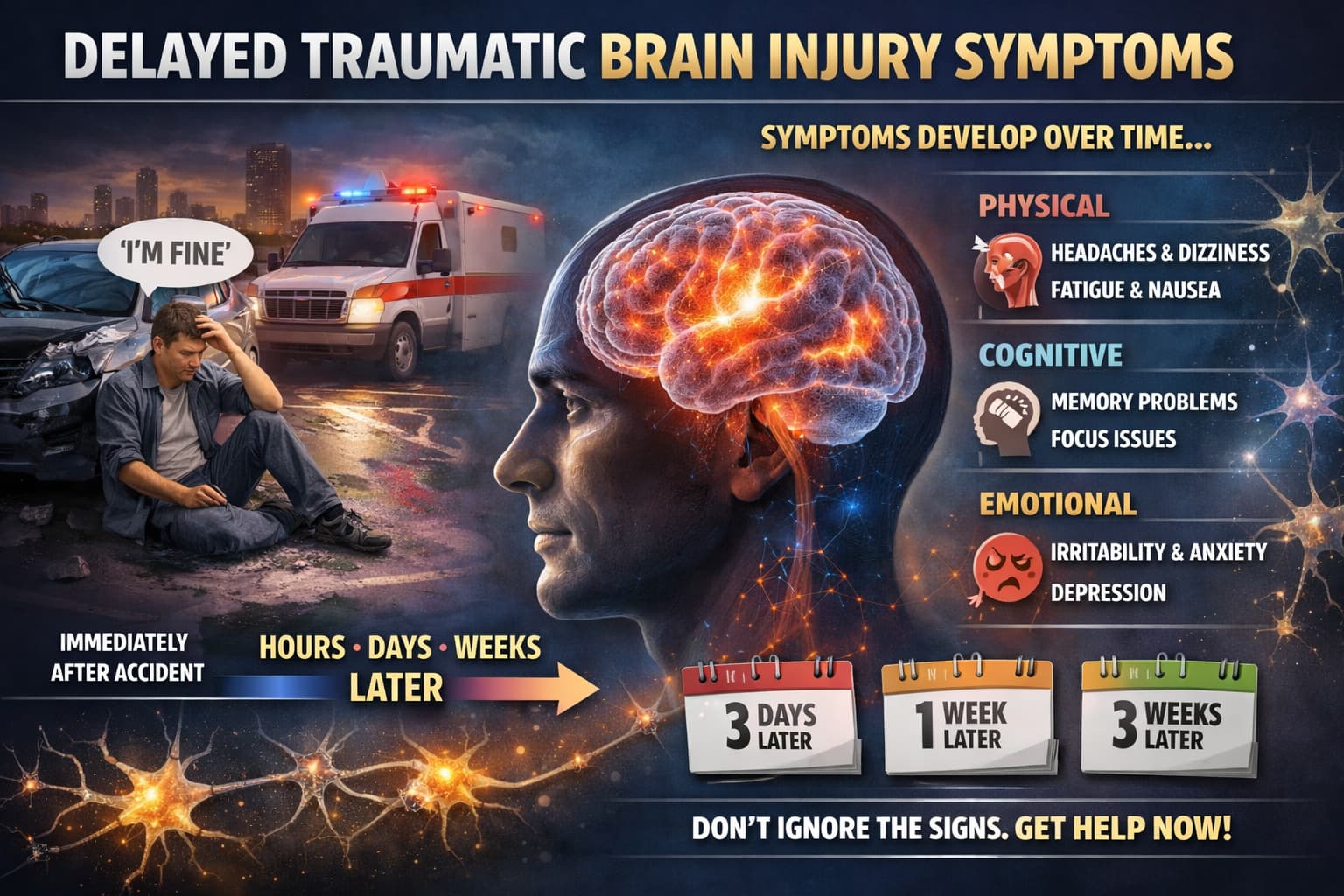
TBI symptoms take time to appear because a brain injury is not just a visible bruise. TBIs are often a cascading internal event.
The Metabolic Cascade
When the brain sustains a mechanical jolt, a rapid and chaotic metabolic cascade begins. Neurons fire uncontrollably, demanding massive amounts of energy.
- Initial Overdrive: In the first minutes, the brain attempts to compensate, leading to the brief periods of lucidity often reported by victims.
- Delayed Shutdown: This overwork quickly depletes energy reserves. The brain then shifts into an energy crisis, or shutdown, as it tries to conserve resources. It is during this shutdown phase, which can last for days, that fatigue, brain fog, and cognitive deficits become overwhelmingly obvious.
The Inflammatory Response
Physical trauma triggers an inflammatory response as the body attempts to repair the damaged tissue.
- Swelling and Pressure: Even minor, localized swelling within the confined space of the skull can take time to build up and cause pressure.
- Chemical Imbalances: Neurotransmitters, which are essential for communication between brain cells, become imbalanced. This chemical disruption manifests as delayed symptoms like mood swings, anxiety, and depression.
Part 2: The Three Categories of Delayed TBI Symptoms
Delayed TBI symptoms are generally classified into three groups: physical, cognitive, and emotional/behavioral. It is rare for a victim to suffer from just one group as they usually occur together, creating a profoundly debilitating experience known as Post-Concussion Syndrome (PCS) if they persist longer than three months.
1. Delayed Physical Symptoms
These are the most commonly recognized symptoms, often mistaken for neck or back pain.
| Symptom | Description | Legal Significance |
| Chronic Headaches | Can range from severe, stabbing migraines to dull, persistent pressure. Often it starts 24–72 hours after the accident. | Must be documented daily in a symptom journal to establish severity and frequency for pain and suffering damages. |
| Vertigo and Dizziness | Feeling unsteady, lightheaded, or experiencing a spinning sensation. Often due to damage to the inner ear/vestibular system. | Requires specialized documentation from a vestibular therapist or neurologist to prove functional impairment. |
| Vision Changes | Blurred vision, double vision, difficulty focusing, or sensitivity to light. | Used to prove direct neurological damage and the need for long-term vision therapy. |
| Fatigue and Sleep Disruption | Profound, overwhelming fatigue unrelated to exertion. Difficulty falling or staying asleep or sleeping too much. | A key sign of the metabolic energy crisis and vital evidence for chronic life impairment. |
| Nausea and Vomiting | May recur or begin days after the event. Often related to increased intracranial pressure or vestibular issues. | Provides objective physical proof that the TBI is active and ongoing. |
2. Delayed Cognitive Symptoms
These symptoms affect how a person thinks, processes information, and functions in professional and educational settings. They are often the most difficult to prove without specialized testing.
- Difficulty Concentrating: An inability to focus on complex tasks, reading, or conversations. Victims describe it as feeling like their brain is running through wet cement.
- Short-Term Memory Loss: Forgetfulness regarding recent events, conversations, or instructions. Missing appointments or struggling to follow multi-step directions.
- Slowed Processing Speed: Taking significantly longer to perform routine mental tasks, make decisions, or react to stimuli. This is particularly dangerous for drivers and professionals.
- Executive Function Impairment: Trouble with planning, organizing, initiating tasks, and managing time. This symptom often leads to job loss or academic failure.
- "Word-Finding" Difficulties: The inability to quickly recall common words or articulate layered thoughts, leading to frustration and social withdrawal.
Legal Challenge: Cognitive decline is easily dismissed as "stress" or "aging" by the defense. To overcome this, we refer clients for objective neuropsychological testing, which quantifies these invisible deficits.
3. Delayed Emotional and Behavioral Symptoms
The frontal and temporal lobes, which govern personality and emotion, are highly susceptible to rotational force injuries in crashes. Damage here can cause profound, delayed personality shifts that strain family relationships.
- Irritability and Mood Swings: Uncharacteristic outbursts of anger, frustration, or impatience that were not present before the accident.
- Anxiety and Depression: The TBI can chemically trigger or intensify existing mental health conditions. Anxiety about the future or the injury itself is common.
- Emotional Lability: Inability to control emotional responses (crying easily or laughing inappropriately).
- Social Withdrawal: Avoiding friends, family, and activities due to the effort required to concentrate, or sensitivity to noise and light.
- Loss of Empathy or Initiative: A change in motivation or a reduced ability to understand others’ emotions, often reported by spouses and close family members.
Family Testimony is Crucial: Evidence of emotional change relies heavily on the testimony of collateral witnesses, spouses, children, or colleagues, who can provide irrefutable proof of the shift between the pre-accident and post-accident personality.
Part 3: The Critical Legal Challenges of Latent TBI Symptoms
The delay in symptoms is the central pillar of the defense strategy used by insurance companies in Texas.
1. The "Pre-Existing Condition" Argument
If you didn't report headaches at the ER, but they started five days later, the insurance company will argue they are related to a pre-existing condition, stress, or a subsequent, minor incident.
- Our Defense Strategy: We meticulously review your entire medical history to prove a clean neurological baseline before the accident. We then use chronology and continuity of care, ensuring you see a doctor immediately when symptoms begin, to establish the undeniable causal link back to the accident.
2. Attacking Credibility (The "Malingering" Defense)
When symptoms are subjective (like memory loss or pain), the defense often attempts to paint the victim as a "malingerer" (someone faking or exaggerating injury for financial gain).
- The Tactic: Defense attorneys look for gaps in treatment, inconsistent journal entries, and social media posts that appear to contradict the claimed level of disability.
- Our Defense Strategy: We counter this with overwhelming objective evidence:
- Neuropsychological Testing: These tests include validity measures that detect poor effort, effectively defeating the malingering argument when effort is proven high.
- Advanced Imaging (DTI): Showing the jury actual structural damage (Diffuse Axonal Injury) that correlates with the symptoms proves the injury is real and physical, not fabricated.
3. The Danger of Early Settlement
Because delayed symptoms can turn a minor concussion into a permanent case of PCS, settling too early is catastrophic.
- The Trap: An insurance adjuster may offer a quick, low-value settlement within weeks of the accident, hoping the victim accepts before the onset of chronic symptoms like chronic fatigue or severe cognitive decline.
- The Rule: We advise clients never to settle a TBI case until they have reached Maximum Medical Improvement (MMI) and a specialized doctor has provided a final Impairment Rating. This ensures the settlement covers the full lifetime cost of care.
Part 4: What You Must Do Immediately When Symptoms Appear
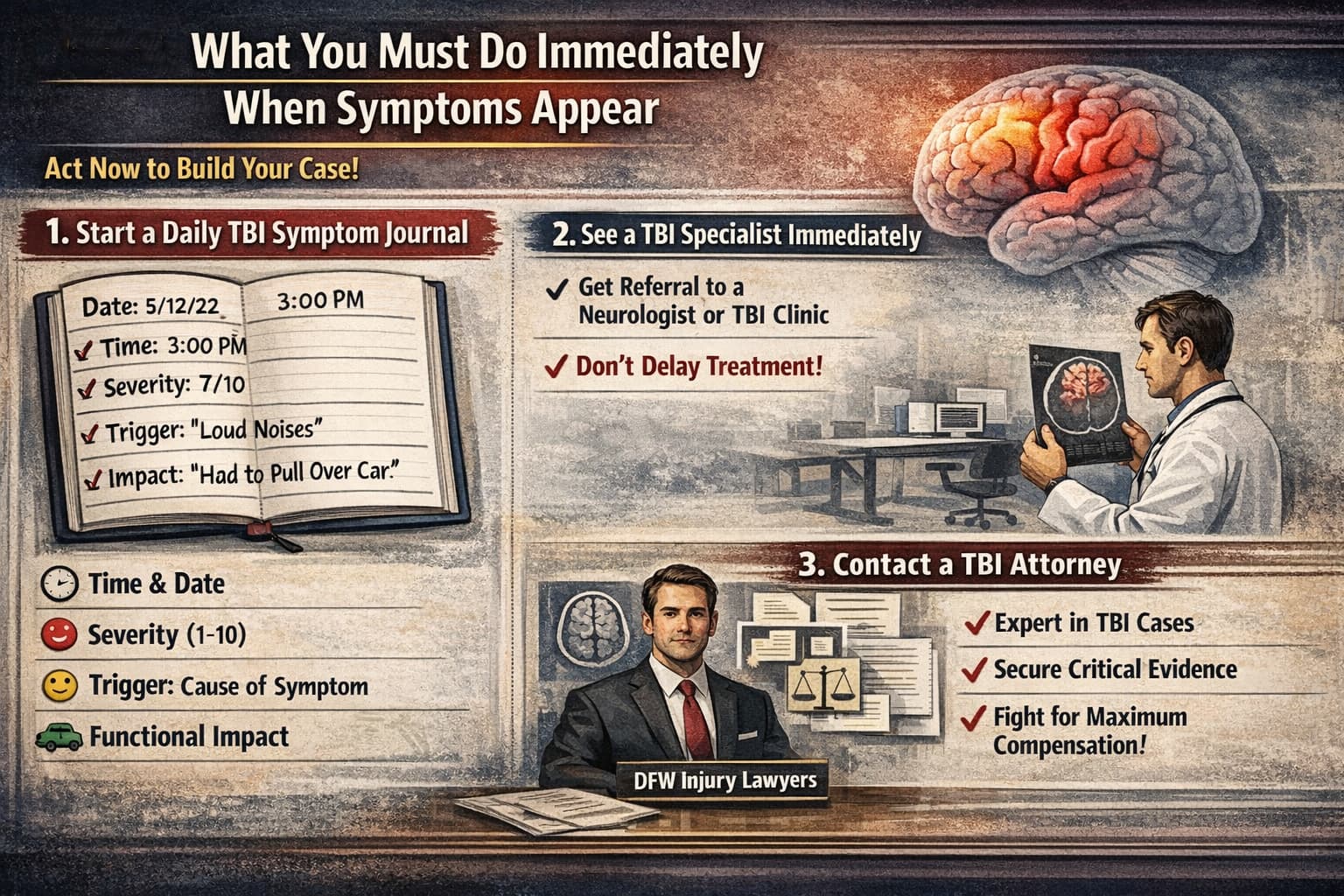
If you notice any of the delayed symptoms listed above, act immediately. Your actions are the only way to build the legal documentation necessary for success.
1. Start a Daily TBI Symptom Journal
This is your most valuable documentation tool. Record specific details every day:
- Time and Date: When the symptom occurred.
- Severity: Rate it on a scale of 1 to 10.
- Trigger: What caused the symptom (e.g., "Loud noises," "Reading for 15 minutes," "Driving in traffic").
- Functional Impact: How did it stop you? (e.g., "Had to pull over the car," "Couldn't finish the email," "Had an emotional outburst.")
2. See a TBI Specialist Immediately
Go back to your doctor, explain the onset of delayed symptoms, and demand a referral to a neurologist or TBI clinic. Do not delay. The gap between the accident date and the start of treatment is the defense’s greatest weapon.
3. Contact a TBI Attorney
Delayed symptoms fundamentally change the valuation and complexity of your claim. A general practice attorney may not know how to secure and litigate evidence like Neuropsychological Testing or DTI scans.
DFW Injury Lawyers know the specific language, medical experts, and legal strategy required to connect latent symptoms back to the moment of trauma, all but guaranteeing the insurance company respects the severity of your TBI.
Why Choose Us?
Litigating a TBI claim with delayed symptoms is a field that demands more than general personal injury experience. It requires a firm ready to invest time and resources to defeat the insurance defense's "delayed symptom" argument.
1. Experience in Proving Latent Causation
We establish the chronological and scientific link between the accident and symptoms that appear weeks later. We know how to use the biological evidence (the metabolic cascade) and documentation continuity to refute the defense's claim of intervening or pre-existing conditions.
2. Access to Diagnostic Experts
Winning a delayed-symptom TBI case requires objective proof. We maintain a strong network of Neuropsychologists and neuroradiologists who can perform and testify on the objective evidence that standard MRIs miss, including neuropsychological testing to quantify cognitive loss and Diffusion Tensor Imaging (DTI) to prove micro-structural damage.
3. Comprehensive Lifetime Valuation
Delayed TBI symptoms often indicate Post-Concussion Syndrome (PCS), which can last a lifetime. We work with forensic economists and life care planners to calculate the full, permanent cost of your injury.
The cost can range from lost earning capacity to decades of future therapy and specialized care. We refuse to accept low-ball settlements that ignore the long-term reality of TBIs.
Protect Your Future from the Invisible Injury
The period of delayed symptom onset is a terrifying and confusing time, both medically and legally. It is a time when the invisible damage to your brain reveals its devastating reality.
Do not let the adrenaline of the accident dictate your legal outcome. If you have experienced any blow to the head and are now struggling with delayed TBI symptoms in Texas, your future depends on immediate legal action.
DFW Injury Lawyers is dedicated to ensuring the true, long-term impact of your TBI is fully documented, medically proven, and aggressively valued. We invest in the advanced testing and medical testimony required to defeat the insurance defense’s tactics and attempt to secure the compensation you need for long-term care and recovery.
Contact us today for a free, confidential case evaluation with an experienced personal injury lawyer. We will begin building your evidence immediately to prove that your invisible injury deserves justice.
Call (972) 440-2320 or fill out our online form now.

Kevin L. Edwards
Founder
Attorney Kevin Edwards is a co-founder of DFW Injury lawyers. Over the last 15 years, Mr. Edwards has dedicated his practice to helping those who have been injured or harmed by the negligence, malfeasance, and/or recklessness of others.
Author's Bio