The idea that pedestrians are universally protected and always have the right of way is not always true. Many people, both on foot and behind the wheel, operate under the assumption that if an accident occurs, the driver is automatically at fault. The legal reality in Texas is far more nuanced.
While Texas law imposes a significant duty of care on drivers to watch out for vulnerable pedestrians, it also holds pedestrians responsible for obeying traffic laws, crossing safely, and avoiding reckless behavior.
When a pedestrian accident occurs the immediate legal battle often centers on comparative negligence, determining who was actually at fault, and by what percentage. If you or a loved one has been struck by a vehicle while walking, jogging, or cycling, the insurance company for the driver will immediately try to exploit any perceived fault on the pedestrian's part.
At DFW Injury Lawyers, we understand that proving the driver’s negligence is essential, even when the pedestrian has made a mistake. Our mission is to cut through the confusion, establish the true cause of the accident, and secure maximum compensation for victims of catastrophic pedestrian injuries.
Our guide will clarify the specific Texas right-of-way laws, expose the dangerous assumptions that lead to accidents, and detail the legal strategies we employ to protect you.
Call (972) 440-2320 to discuss your case with a Texas pedestrian accident lawyer at DFW Injury Lawyers.
Key Takeaways: Pedestrian Right-of-Way in Texas
- The Myth vs. Reality: Pedestrians do not always have the right of way. It is a legal designation that shifts based on location and obedience to traffic laws.
- The Driver’s Duty: Even when a pedestrian is technically at fault (e.g., jaywalking), the driver retains an overarching duty of care to avoid the collision if possible, which is crucial for establishing liability.
- Comparative Negligence is Key: Texas uses the 51% bar rule. If the injured pedestrian is found to be 51% or more at fault, they recover nothing. The defense will fight hard to prove the pedestrian was primarily responsible.
- Proof Requires Forensics: Because the driver's word is often biased, winning catastrophic pedestrian injury cases requires evidence like Event Data Recorder (EDR) analysis, cell phone records, and accident reconstruction to prove driver negligence.
- Never Settle Early: Do not accept a quick settlement until a personal injury firm has fully investigated all evidence to minimize the comparative fault assigned to the pedestrian.
Part 1: Texas Right-of-Way Laws—The Rules for Pedestrians and Drivers
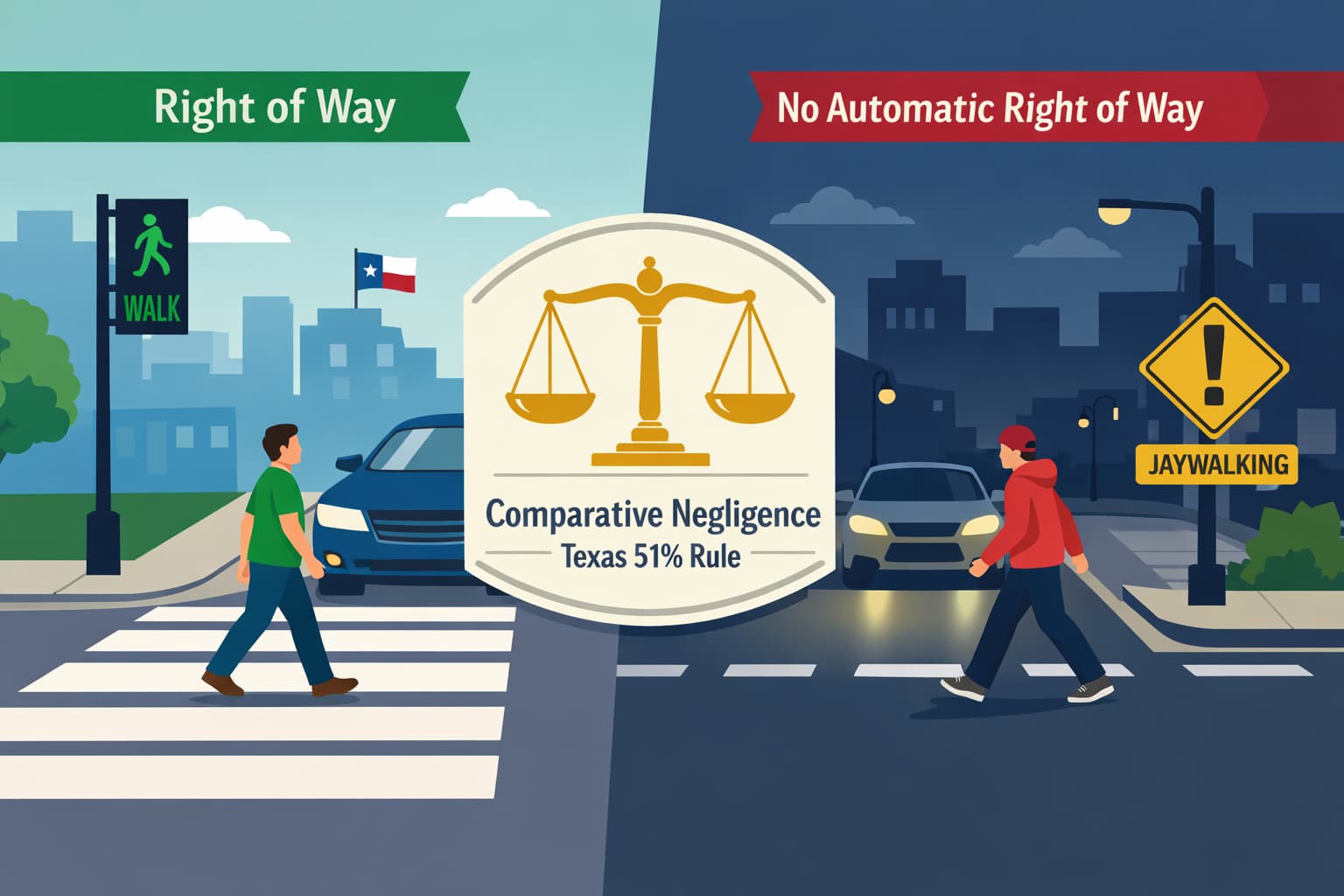
Texas Transportation Code, Chapters 545 and 551, clearly defines the responsibilities for both drivers and pedestrians. The law recognizes that right-of-way is not an inherent right but a legal designation that shifts based on location and traffic control devices.
1. Where the Pedestrian Has the Right of Way
The law is clear that drivers must yield to pedestrians in designated locations:
- Crosswalks (Marked and Unmarked):
- Marked Crosswalks: Pedestrians legally have the right of way when entering a marked crosswalk.
- Unmarked Crosswalks: This is the most misunderstood area. At any intersection where sidewalks meet, an "unmarked crosswalk" legally exists, even without painted lines. If the pedestrian is already in this unmarked crosswalk and traffic control signals allow them to proceed, drivers must yield.
- The Driver’s Duty: Drivers approaching a vehicle stopped at a crosswalk must also stop, ensuring they do not pass the stopped car and strike a pedestrian.
- When Signal Indicates Walk: Pedestrians must obey all "Walk" and "Don't Walk" signals. When the signal explicitly grants the right-of-way, drivers must yield, even if turning.
- Sidewalks and Safety Zones: Drivers must yield to pedestrians on a sidewalk and must avoid driving into safety zones.
2. When the Driver Has the Right of Way
The myth that pedestrians always have the right of way is dangerous because there are many situations where the law requires the pedestrian to yield to vehicular traffic.
- Crossing Mid-Block (Jaywalking): A pedestrian crossing a street at any point other than a marked or unmarked crosswalk is generally committing the violation of jaywalking. In this scenario, the pedestrian must yield the right of way to all vehicles.
- Entering a Roadway Suddenly: A pedestrian emerging from a place of safety (like a curb or sidewalk) must not enter a roadway into the path of a vehicle so close that it constitutes an immediate hazard. This applies especially when stepping into traffic without checking for oncoming cars.
- Ignoring Signals: If a pedestrian crosses against a "Don't Walk" sign or fails to obey a traffic officer, they lose their right of way designation.
The Driver’s Overarching Duty of Care
Even when the pedestrian is technically at fault, the law still holds drivers to an overarching duty of care. A driver cannot simply ignore a jaywalking pedestrian if they have time and space to avoid hitting them. The Texas Transportation Code requires drivers to:
- Exercise due care to avoid colliding with a pedestrian.
- Give warning by sounding the horn when necessary.
- Exercise proper precaution on observing a child or an obviously confused or incapacitated person.
This duty of care means that even if the pedestrian committed a technical violation, a lawsuit can still succeed if the driver’s negligence was the proximate cause of the collision.
Part 2: Comparative Negligence in Texas
In a Texas pedestrian accident case, the insurance company will aggressively argue that the pedestrian was partially at fault, citing violations like jaywalking or distraction. This is where the Texas law of proportionate responsibility (comparative negligence) becomes central to the outcome.
The 51% Bar
Texas operates under a modified comparative negligence system, often called the "51% bar."
- The Rule: A claimant (the injured pedestrian) can recover damages only if their fault is found to be 50% or less. If a jury determines the pedestrian was 51% or more at fault, they recover nothing.
- The Reduction: If the pedestrian is found to be partially at fault (e.g., 20%), their total damage award is reduced by that percentage. (A $1 million award becomes $800,000).
Example of Comparative Negligence in Action:
- A pedestrian is crossing outside the crosswalk (jaywalking) but is walking predictably down the street. (Pedestrian: 30% Fault)
- The driver is looking at a cellphone and drifts out of their lane, hitting the pedestrian. (Driver: 70% Fault)
- Since the pedestrian's fault is less than 51%, they can recover 70% of the total damages.
This is the legal fight we prepare for. The defense tries to push the pedestrian's fault above 50% to win the case outright. We focus on demonstrating that even if the pedestrian made an error, the driver’s actions were the primary, unavoidable cause of the collision.
Part 3: How We Investigate Pedestrian Accidents
Because the pedestrian is vulnerable and the driver's perspective is often the only immediate testimony, proving the true sequence of events requires legal investigation. Our firm deploys accident reconstruction experts and advanced technology immediately to counter the narrative presented by the driver and the insurance company.
1. Accident Reconstruction and Vehicle Data
We don't rely solely on eyewitnesses or police sketches. We utilize engineering and scientific analysis to prove the driver’s negligence:
- Speed and Impact Analysis: Accident reconstructionists calculate the speed and angle of impact based on skid marks, vehicle damage, and the pedestrian's resulting location. This often proves the driver was speeding or failed to brake in time.
- Event Data Recorder (EDR) Analysis: Most modern vehicles have "black boxes" that record critical information in the seconds leading up to a crash, including speed, brake application, and steering angle. We move quickly to secure and analyze this data to prove driver misconduct.
2. Proving Distracted Driving
Driver distraction is a leading cause of catastrophic pedestrian accidents. Since drivers rarely admit to being on their phones, we launch a forensic investigation:
- Cell Phone Records: We subpoena the driver’s cell phone records to prove they were texting, calling, or using data in the moments immediately preceding the collision. This is powerful evidence of negligence that defeats the "I didn't see them" defense.
3. Visibility and Sightline Studies
The defense often claims the pedestrian "darted out" or was invisible. We counter this by analyzing the scene's geometry:
- Line of Sight: Our expert analysts conduct sightline studies to determine exactly when a reasonably attentive driver should have been able to see the pedestrian. If the driver had 5 seconds of visibility but didn't react, their claim of "sudden emergence" is proven false.
- Lighting and Weather: We gather data on ambient light, weather, and road conditions to counter claims of poor visibility, often proving that the driver’s speed was unsafe for the conditions.
4. Collateral Damage and Scene Documentation
We meticulously document all physical evidence:
- Debris Field and Shoe Scuffs: The location and trajectory of debris and shoe scuff marks on the road help establish the point of impact and the speed of the vehicle.
- Surveillance Video: We immediately search for traffic camera footage, nearby business security cameras, or dashcam footage from surrounding vehicles that may have captured the moments leading up to the collision. This often provides irrefutable proof of the driver’s or pedestrian’s actions.
Part 4: Common Pedestrian Mistakes That Complicate a Claim
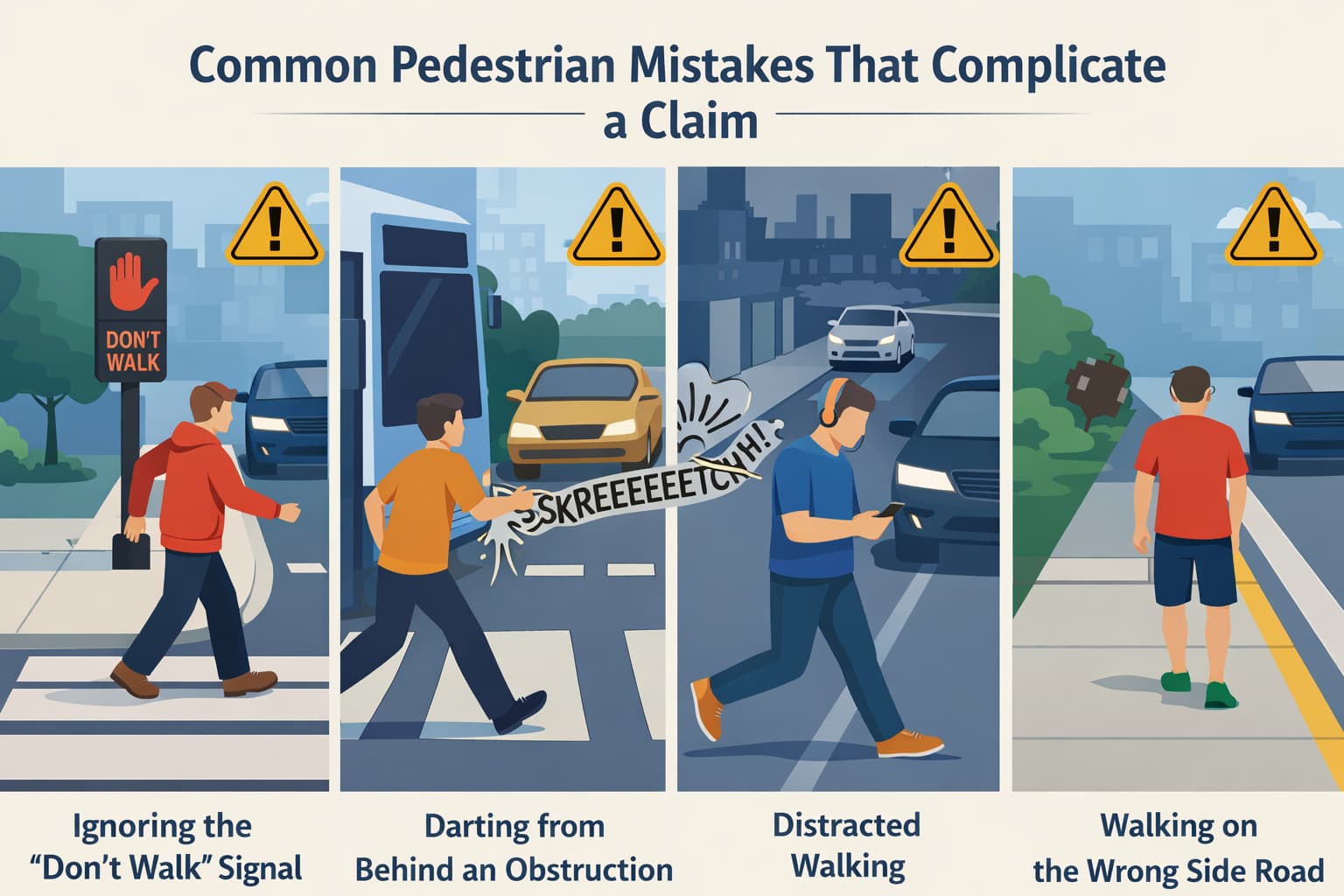
While our legal strategy is designed to minimize the impact of pedestrian error, it is vital for individuals to understand the actions that place them at significant legal risk:
- Ignoring the "Don't Walk" Signal: If a pedestrian enters the crosswalk when the flashing "Don't Walk" signal or steady hand signal is present, they risk being held responsible for the crash.
- Darting from Behind an Obstruction: Stepping suddenly into traffic from behind a parked bus, delivery truck, or large van dramatically reduces the driver’s reaction time and strongly supports the driver’s claim of sudden emergence.
- Distracted Walking: While less strictly enforced than distracted driving, a pedestrian engrossed in a phone conversation, texting, or wearing noise-canceling headphones is functionally impaired. If we can prove the driver was also distracted, the case moves to comparative negligence. However, if the driver was attentive, the pedestrian's distraction may be cited as contributing fault.
- Walking on the Wrong Side of the Road: When no sidewalk is available, Texas law requires pedestrians to walk on the left side of the roadway, facing oncoming traffic. Walking with traffic (on the right side) is a violation that can be cited as negligence.
The Role of Your DFW Injury Lawyer: Even if you committed one of these errors, your ability to recover compensation is not automatically forfeited. Our role is to prove that the driver’s high degree of negligence was the overriding and proximate cause of the injury, regardless of the pedestrian’s minor error.
Don't Let the Myth Stop Your Recovery
The myth that pedestrians always have the right of way is often used by insurance companies to scare victims into accepting low-ball settlements. They will argue over every percentage point of fault to reduce or eliminate their payout for your catastrophic injuries.
If you have suffered severe injuries your future depends on securing maximum compensation for medical bills, lost wages, and long-term care. You cannot afford to let the legal complexity of comparative negligence be determined by another attorney.
At DFW Injury Lawyers, we are prepared for this fight. We understand the specific nuances of Texas Transportation Code, and we deploy cutting-edge forensic experts to transform circumstantial evidence into irrefutable proof of driver negligence.
We ensure that the focus remains where it belongs: on the driver's failure to operate their vehicle with the extreme care required around vulnerable individuals. Protect your rights and secure the representation you need to win against the insurance giants.
Contact us today for a free, confidential case evaluation with a seasoned Texas personal injury lawyer. We will immediately investigate the scene, secure the EDR data, and begin building a scientifically grounded case to prove the driver’s liability and attempt to secure full compensation.
Call (972) 440-2320 or fill out our online form now.

Pedro “Peter” de la Cerda
Founder
Attorney Pedro “Peter” de la Cerda is a co-founder of DFW Injury Lawyers. As a young attorney looking for courtroom experience, Mr. de la Cerda began his career defending physicians, nurses, hospitals, trucking, and manufacturing companies in disputes involving personal injury, medical malpractice, products liability, and toxic tort. After seeing many people who were truly injured and deserving of fair compensation, however, Mr. de la Cerda was moved to cross the courtroom aisle and prosecute cases on behalf of plaintiffs in personal injury cases.
Author's Bio