The Dallas-Fort Worth Metroplex is synonymous with growth. Its’ projects promise future efficiency however, they currently represent some of the most perilous environments on Texas roadways.
Construction zones are inherently chaotic places where speed, visibility, and driver expectations are constantly challenged, dramatically increasing the risk of catastrophic accidents.
If you have suffered a serious injury, or lost a loved one, in a Dallas construction zone accident, your case is vastly more complex than a car crash. Liability may not rest solely with the other driver as it could involve the construction company, the general contractor, or even a negligent government entity responsible for planning and signage.
At DFW Injury Lawyers, we are skilled in cutting through the legal layers. We investigate not just the driver’s negligence, but also the negligent design, poor traffic control, and inadequate warning that turned a temporary work area into a permanent danger zone.
Our guide breaks down exactly why Dallas construction zones are so dangerous, the types of accidents that result, and the critical steps required to prove liability and secure the compensation you may deserve.
Call (972) 440-2320 to discuss your case with our experienced Dallas construction accident lawyer.
Key Takeaways: Construction Zone Accident Risks
- Ubiquitous Hazards: DFW construction zones create unique dangers like rapid lane narrowing, uneven pavement, and poor temporary lighting that cause sudden, dangerous maneuvers.
- Primary Accident Types: Rear-end collisions are most common due to sudden deceleration warnings, but sideswipe and catastrophic head-on accidents result from confusing or missing lane delineation.
- Multi-Party Liability: The negligent driver is only one defendant. Liability often rests with the Construction Company/General Contractor for failing to adhere to the Traffic Control Plan (TCP) or maintain proper signage and debris removal.
- Crucial Evidence: Evidence is perishable. You must immediately document the specific road hazard (e.g., missing warning signs, unexpected lane drop-offs) before the contractor fixes it. Drone footage and time-stamped video are often necessary.
- Legal Need: Catastrophic injuries require a firm with deep knowledge of the Manual on Uniform Traffic Control Devices (MUTCD) and the ability to deploy engineering experts to connect contractor negligence directly to the crash.
Part 1: The Ubiquity of DFW Construction Hazards
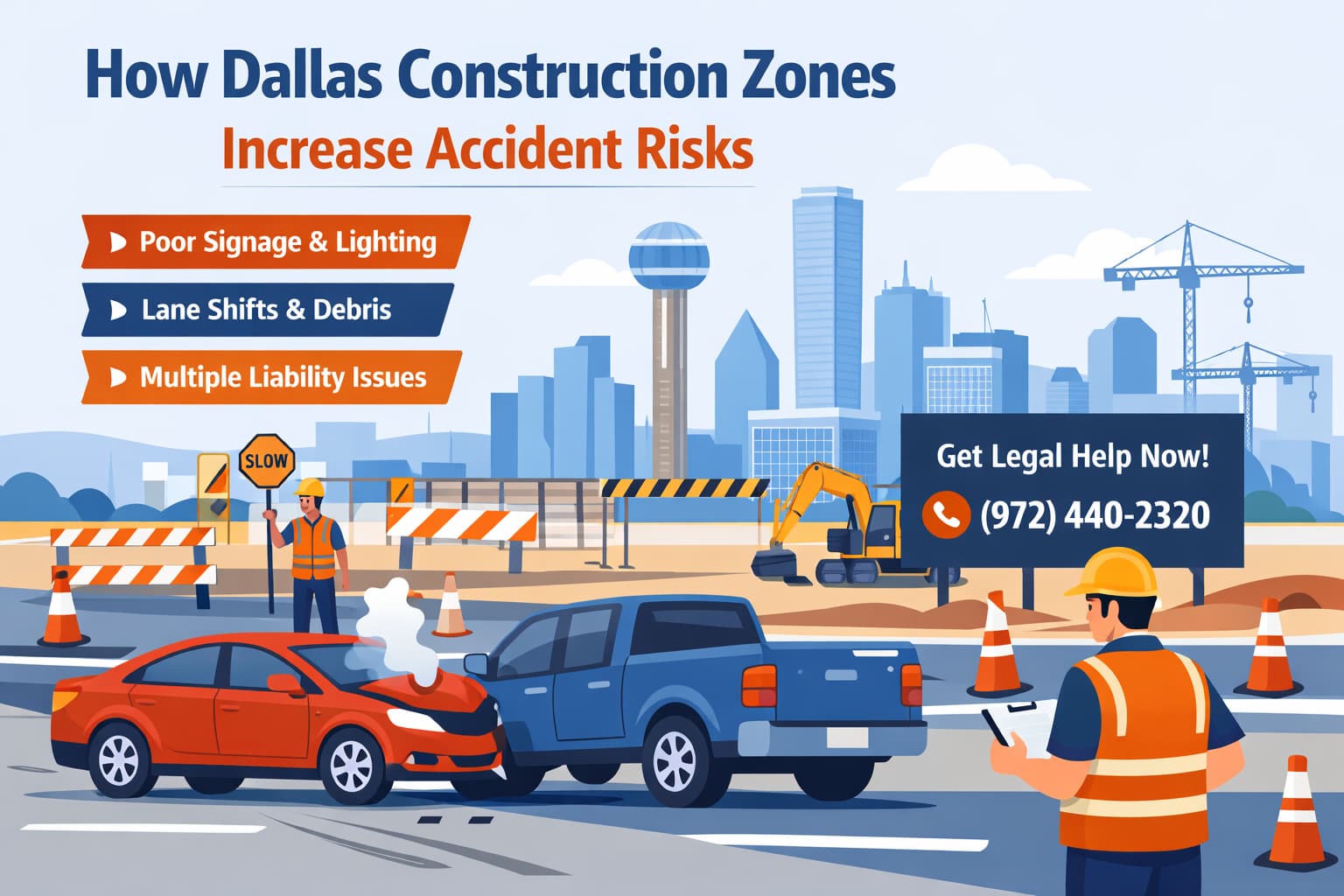
Dallas-Fort Worth is in a perpetual state of road modification, making construction zone safety a daily concern for millions of drivers. The sheer volume of traffic combined with Texas’s aggressive highway development schedule creates a unique and sometimes deadly formula for risk.
The core problem lies in the forced interaction between high-speed traffic flow and unpredictable, temporary road conditions. Drivers, accustomed to certain lane widths, surfaces, and sightlines, are suddenly confronted with an environment optimized for construction workers, not commuters.
The Major Risk Factors Unique to DFW Work Zones
- Aggressive Merging and Lane Narrowing: The sudden loss of a lane on a congested highway during peak hours forces rapid, aggressive merging. This frequently leads to sideswipe accidents and rear-end collisions as drivers panic or brake suddenly. Signage often fails to give drivers adequate advance warning of these closures.
- Uneven and Damaged Pavement: Construction involves heavy vehicle traffic and utility work, resulting in uneven lanes, sudden drop-offs between pavement levels, temporary ramps, and large potholes. These defects can cause drivers to lose control, hydroplane in the rain, or suffer tire blowouts, particularly at speed.
- Poor Lighting and Night Work: Much of the major construction in Dallas occurs at night to minimize daytime congestion. While this mitigates some traffic issues, it vastly increases the risk of accidents due to reduced visibility. Construction at night makes lane changes and obstacle detection extremely difficult.
- Confusion and Misplaced Signage: This is perhaps the most egregious failure in many construction zone accident cases. Federal and state regulations dictate the precise placement, size, and type of warning signs required. When contractors do not place these signs they create a hazard that can lead to driver disorientation and catastrophic accidents.
Part 2: Analysis of Common Construction Zone Accidents
Construction zone conditions dictate the type of accident, often leading to more violent, high-speed impacts due to the lack of adequate run-off space and sudden changes in deceleration.
1. Rear-End Collisions: The Most Frequent Danger
Rear-end accidents are the most common incident in work zones, often occurring at the point where traffic decelerates from highway speed to zero.
- The Cause: This is primarily due to a failure to warn of sudden deceleration. If advanced warning signs for "Road Work Ahead" or "Reduced Speed" are missing, faded, or placed too close to the hazard, the following driver has insufficient time to react.
- The Impact: These collisions often lead to whiplash, serious spinal injuries, and Traumatic Brain Injuries (TBIs), especially if the victim's head strikes the steering wheel or headrest violently.
2. Sideswipe and Lane Change Accidents
When lanes narrow and drivers are forced to merge, sideswipe accidents become prevalent.
- The Cause: Drivers misjudge the reduced clearance, especially in temporary lanes that are narrower than standard shoulders. Aggressive drivers attempt last-second merges. Truck drivers, who require greater lateral space, often sideswipe passenger vehicles pinned between the truck and a barrier.
- The Impact: These accidents frequently result in the victim's vehicle being pushed into a fixed object, leading to severe rotational injuries.
3. Construction Debris and Projectile Accidents
The work zone itself can be the source of the danger. Loose construction materials, tools, or objects falling from equipment pose significant risks.
- The Cause: Poor housekeeping or securing of tools, materials, and equipment. This includes loose asphalt, rocks flung by tires, or unsecured loads falling from construction vehicles.
- The Impact: Projectiles striking the vehicle can shatter windshields, leading to lacerations, or cause drivers to react violently and swerve into adjacent traffic.
4. Head-On and Crossover Accidents
These are the most catastrophic types of construction zone accidents, often resulting in fatalities or permanent disability.
- The Cause: They are typically the result of confusing, misleading, or missing lane markers that cause a driver to inadvertently cross into opposing traffic lanes, often separated only by temporary cones or inadequate barriers. This is a common failure in work zone planning.
Part 3: Determining Liability Beyond the Driver
In a standard car accident, liability is usually clear: Driver A hit Driver B, and Driver A is responsible. In a Dallas construction zone accident, multiple parties may share responsibility, and identifying all negligent parties is essential to securing full compensation.
1. The Negligent Driver
First and foremost, the driver who caused the direct impact is liable. However, their insurance policy limits may not cover the full extent of a TBI or spinal injury caused by a high-impact crash. This is where pursuing secondary liability becomes critical.
2. The Construction Company and General Contractor
The private company contracted to perform the construction work has a non-delegable duty to maintain a reasonably safe working area for the traveling public. Failures often stem from:
- Failure to Follow Traffic Control Plans: The general contractor must adhere strictly to the detailed traffic plans approved by the state. Deviating from these plans, such as placing barriers incorrectly or failing to close off designated areas, constitutes negligence.
- Inadequate Signage and Lighting: The contractor is responsible for installing, maintaining, and inspecting all warning signs, flaggers, cones, and temporary lighting. If a sign is missing, faded, or pointing the wrong way, the contractor is likely negligent.
- Improper Road Maintenance: Failing to promptly fill potholes, remove debris, or fix sudden lane drop-offs created by their equipment or work falls directly on the contractor.
3. The State or Government Entity
In certain cases, the Texas Department of Transportation (TXDOT) or a local municipality may be held liable under specific legal exceptions outlined in the Texas Tort Claims Act.
- Negligent Design: If the design of the traffic control plan was inherently flawed, creating an unreasonable risk that led to the accident, TXDOT may bear liability.
- Known Hazard Failure: If TXDOT was notified (or should have known) of a dangerous condition created by the construction and failed to correct it or force the contractor to correct it, they may be partially responsible.
The DFW Injury Lawyers Advantage: Our firm does not stop at the police report. We subpoena the contract, the Traffic Control Plan (TCP), daily inspection logs, and internal communications of the construction company to find proof that their failure to follow safety standards contributed to your injuries.
We understand the stringent, specific requirements of the Manual on Uniform Traffic Control Devices (MUTCD), which dictates proper signage, and we hold contractors accountable when they fail to meet these standards.
Part 4: Building an Undeniable Construction Zone Accident Claim
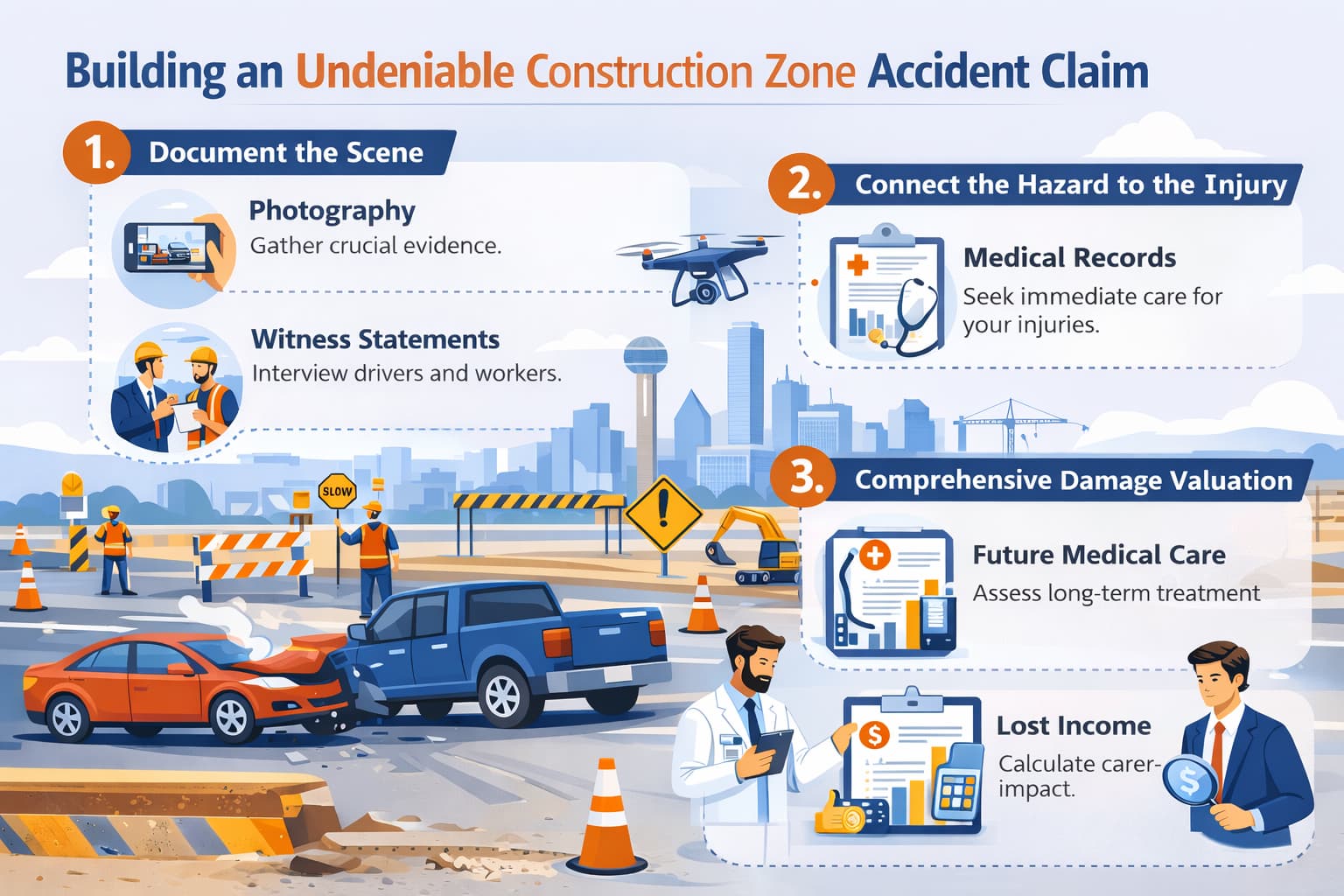
A successful claim requires immediate action and evidence collection to prove how the negligence of the driver and the construction company converged to cause your injuries.
1. Document the Scene
If possible, try to ensure that critical documentation occurs immediately, as the construction company will correct safety deficiencies quickly once an accident happens.
- Photography: Capture photos of the accident scene that specifically show the hazard: missing signs, obscured markers, poorly maintained lane drop-offs, the distance of the first warning sign from the lane closure, and the condition of the pavement.
- Witness Statements: Obtain contact information not just from other drivers, but from any construction workers who saw the crash or were working nearby. Their testimony about pre-existing hazards is invaluable.
- Drone and Time-Stamped Video: Your attorney will dispatch investigators to gather drone footage or other mapping data to freeze the scene's condition before the contractor can make changes.
2. Connect the Hazard to the Injury
Your medical documentation must not just confirm your injury, but also connect the mechanism of injury to negligence.
- Medical Records: Seek immediate care for your injuries.
- Engineering Experts: We rely on accident reconstructionists and civil engineers to analyze the traffic control plan and determine that, for instance, the missing "Slow Down" sign was the direct cause of the driver’s sudden braking and subsequent rear-end collision.
3. Comprehensive Damage Valuation
Construction zone accidents often result in severe injuries due to the high speeds and unforgiving barriers involved. Your damages may include:
- Future Medical Care: Years of physical therapy, multiple surgeries, and long-term symptom management.
- Lost Earning Capacity: If a spinal cord injury or TBI prevents you from returning to your profession, a forensic economist must calculate the total loss over your lifetime.
- Pain and Suffering: Compensation for the chronic pain, loss of mobility, and diminished quality of life caused by the catastrophic injury.
Why Choose Us?
Handling a construction zone accident in Dallas means fighting not just an insurance company, but potentially a powerful general contractor and even government lawyers. This requires a legal team with demonstrated experience.
1. We Investigate the Contractor, Not Just the Driver
Our focus immediately expands beyond the driver’s policy limits. We dedicate resources to investigating the construction company’s compliance history, OSHA violations, internal safety logs, and adherence to the TCP. We treat the poorly maintained construction site as a second negligent party.
2. Deep Knowledge of Texas Roadway Regulations
We are intimately familiar with the legal standards and federal guidelines governing construction zones. We know exactly what signs should have been present, where they should have been placed, and what maintenance was required. This allows us to pinpoint contractor negligence that general practitioners often overlook.
3. Experienced Trial Attorneys for Catastrophic Injuries
Construction zone accidents frequently result in catastrophic injuries. We are not a settlement mill and we prepare every case for trial. We ensure that we have the expert engineers, accident reconstructionists, and medical specialists lined up to prove liability against all responsible parties and secure settlement verdicts.
Don't Let Poor Planning Determine Your Future
The construction booms driving growth across Dallas and Fort Worth are great for the economy, but they should never come at the cost of your safety. When negligence, be it from a speeding driver or a careless construction crew, turns a temporary work zone into a scene of life-changing trauma, you have the right to demand justice from every responsible party.
Do not accept a limited settlement offer based only on the driver's policy. Your severe injuries demand a full investigation into the construction company's role in the crash. If you or a loved one has suffered a catastrophic injury in a Dallas construction zone, the time to act is now, before the contractor erases the evidence.
Contact DFW Injury Lawyers today for a free, confidential consultation with an experienced Dallas personal injury attorney. We will dispatch our investigative team immediately to preserve the evidence and begin building a multi-party liability claim designed to attempt to secure full compensation.
Call (972) 440-2320 or fill out our online form now.

Kevin L. Edwards
Founder
Attorney Kevin Edwards is a co-founder of DFW Injury lawyers. Over the last 15 years, Mr. Edwards has dedicated his practice to helping those who have been injured or harmed by the negligence, malfeasance, and/or recklessness of others.
Author's Bio