Vicarious liability after a car accident in Dallas may allow injured victims to hold an employer responsible when a driver causes a crash while working. If the at-fault driver was on the clock, the company’s commercial insurance policy—not just the driver’s personal coverage—may be liable for the damages.
Determining liability can be especially complex in a Dallas car accident when the at-fault driver was on the clock. Managing medical bills while fighting an uncooperative commercial insurer creates an even bigger headache for injured Dallas residents.
Many people mistakenly assume they only have access to a driver’s individual auto policy. But vicarious liability can make corporate employers legally responsible for an employee’s actions while performing job duties in Dallas County.
When an employee causes a severe collision while performing daily work duties, the law frequently holds the company liable for the property damage and physical injuries. A Dallas car accident attorney can investigate the driver's work history to uncover corporate policies that the worker might try to hide.
Proving a motorist acted within their job during a car crash in Texas shifts the financial focus to a much larger commercial umbrella policy. This can open the door to more potential compensation in a personal injury claim.
Key Takeaways About Vicarious Liability After a Car Accident in Dallas
- Victims frequently overlook massive corporate insurance policies when an at-fault driver uses a personal vehicle.
- Minor work tasks like picking up lunch often bring a corporate entity into the legal picture.
- Determining employer responsibility depends entirely on the specific actions of the driver right before the impact.
- Companies fight incredibly hard to distance themselves from a negligent worker to protect their corporate bottom line.
- Finding evidence of work activity demands an immediate legal investigation before companies delete internal records.
What Is Vicarious Liability?
The legal system uses a concept called vicarious liability to hold a company responsible for the negligent actions of its workers. When a business hires a driver to perform daily tasks, that business takes on the risk of that driver causing harm.
This rule prevents a wealthy corporation from avoiding responsibility by simply blaming a low-level worker. For vicarious liability to apply, the driver must act within the scope of their employment at the exact moment of the crash.
A business operating near Love Field assumes responsibility only if the trip serves a specific corporate purpose. A purely personal detour breaks this legal connection and can shift responsibility back to the individual driver.
Examples of work activities that trigger employer liability for an employee car accident include:
- Making Deliveries: A courier dropping off packages across Dallas County acts directly on behalf of the shipping company.
- Transporting Clients: A professional driver shuttling a customer to a business meeting serves the immediate financial interests of the employer.
- Running Office Errands: A worker driving a personal vehicle to buy printer paper can place liability on the business.
- Traveling Between Job Sites: A construction worker driving a company truck from a site in Uptown to another location remains strictly on the clock.
Proving Vicarious Liability After a Dallas Car Crash Involving Corporate Workers
Determining who is to blame for a lane-change accident on a busy highway like I-35E requires a thorough examination of the driver's actions. Dallas drivers must exercise reasonable caution to protect others. When the driver works for a company, however, the analysis does not stop with individual negligence.
The danger increases significantly when employees rush to meet tight corporate deadlines or attempt to multitask behind the wheel. Corporate pressure often contributes directly to unsafe driving decisions. Distracted workers frequently cause severe collisions near major intersections like Mockingbird Lane and North Central Expressway.
In these situations, holding the employer responsible depends on connecting the driver's negligent act directly to their daily job duties. Some companies place pressure on employees to meet strict deadlines or performance goals, which can influence how and why the employee was driving at the time of the crash.
Determining the specific purpose of the driver's trip becomes key for your attorney to prove the employer's responsibility for the employee's car accident. A thorough investigation into the driver's daily activities uncovers critical details about their true work status at the moment of impact.
Your lawyer relies on several key pieces of information to verify employment activities, including:
- Delivery Logs: Route schedules prove the exact location the driver needed to reach at the precise moment of the impact.
- Cell Phone Records: Call histories reveal whether the employee spoke with a supervisor or a client right before the collision.
- Digital Messages: Text messages outline explicit directions from a manager regarding immediate corporate tasks.
- Company Policies: Employee handbooks demonstrate the specific rules the company expects workers to follow while navigating city streets.
Securing this evidence helps prevent the corporate entity from denying its role in the collision. Proving that an employee caused the harm while performing job-related duties opens the door to suing a company for a car wreck in Dallas.
Can an Employer Be Liable for an Accident in an Employee’s Personal Vehicle?
Companies frequently try to avoid responsibility by pointing out that the worker drove a personal sedan or truck. The name on the vehicle registration doesn’t determine liability in a commercial driving dispute. Texas courts look closely at whether the employee acted within the scope of employment during the trip.
An employer who dictates the maintenance schedule or requires specific tools in the trunk may increase the company’s legal exposure. When a company uses a worker's personal car as an unofficial fleet vehicle, it exposes itself to legal action.
Establishing whether the trip served a work purpose requires a deep dive into the employment agreement. Companies often pay for gas or offer a monthly stipend to offset the costs of using a personal car.
These financial arrangements can support the idea that the vehicle serves a business purpose. A company cannot enjoy the benefits of a mobile workforce while ignoring the dangers those drivers create.
Your legal team identifies specific factors to prove the employer treated the driving as part of the job, including:
- Vehicle Ownership: Registration documents indicate who legally owns the car, but employment contracts reveal whether the employee must use it for work.
- Reimbursement Agreements: Mileage logs can support that the employer pays the worker directly for the specific distance traveled during the day.
- Mandatory Tools: Equipment lists can show the employer expects the driver to transport commercial gear inside a personal trunk.
- Schedule Flexibility: Timecards show when the worker was on the clock.
Holding Companies Accountable Under Texas Law
Bringing a legal claim against a large corporation involves proving the specific relationship between the driver and the company. The legal standard demands evidence that the driver acted within the scope of employment at the time of the crash.
Companies deploy aggressive legal teams to argue that their drivers act entirely on their own behalf. Defeating these arguments requires presenting clear facts about the employment relationship.
Your Dallas car crash lawyer builds a compelling argument that places the blame squarely on the corporate entity.
Assessing the Deviation From Assigned Duties
Workers occasionally veer off their assigned routes to grab a personal snack or run a quick personal errand. The law examines the severity of this deviation to determine if the employer remains liable. A minor detour to a drive-thru window may still keep the driver within the scope of their employment.
A major departure, like driving 20 miles out of the way to visit a friend, severs the connection to the employer. Your attorney investigates the exact geographical route to minimize the impact of any minor deviations.
Identifying Independent Contractors Versus Employees
Companies heavily rely on independent contractors, especially in the trucking industry, to avoid paying benefits and providing commercial insurance coverage. The label an employer places on a worker doesn’t automatically define the legal relationship. Courts analyze the actual day-to-day control the company exerts over the driver's schedule and methods.
If a company dictates exactly how and when a delivery driver works, the law treats that driver as a traditional employee. Reclassifying an independent contractor as an employee opens up access to the larger commercial insurance policy.
Overcoming Common Challenges When Suing a Company for a Dallas Car Wreck
Taking on a commercial insurer requires gathering extensive evidence before the company destroys internal documents. Corporations move quickly after a crash to protect their financial interests and hide damaging information. They may delete digital logs, alter route schedules, and instruct employees to stay quiet about the collision.
A regular driver lacks the resources to force a major corporation to hand over these crucial files. Injured victims face a massive disadvantage when trying to handle these disputes alone. Your Dallas car crash attorney can take immediate action to preserve all relevant data related to the crash.
Sending a preservation letter can put the company on notice to keep its servers and protect digital evidence. This swift intervention can reduce the risk of the employer conveniently losing the records that prove the driver worked that day. Securing this information early in the process creates a solid foundation for your injury claim.
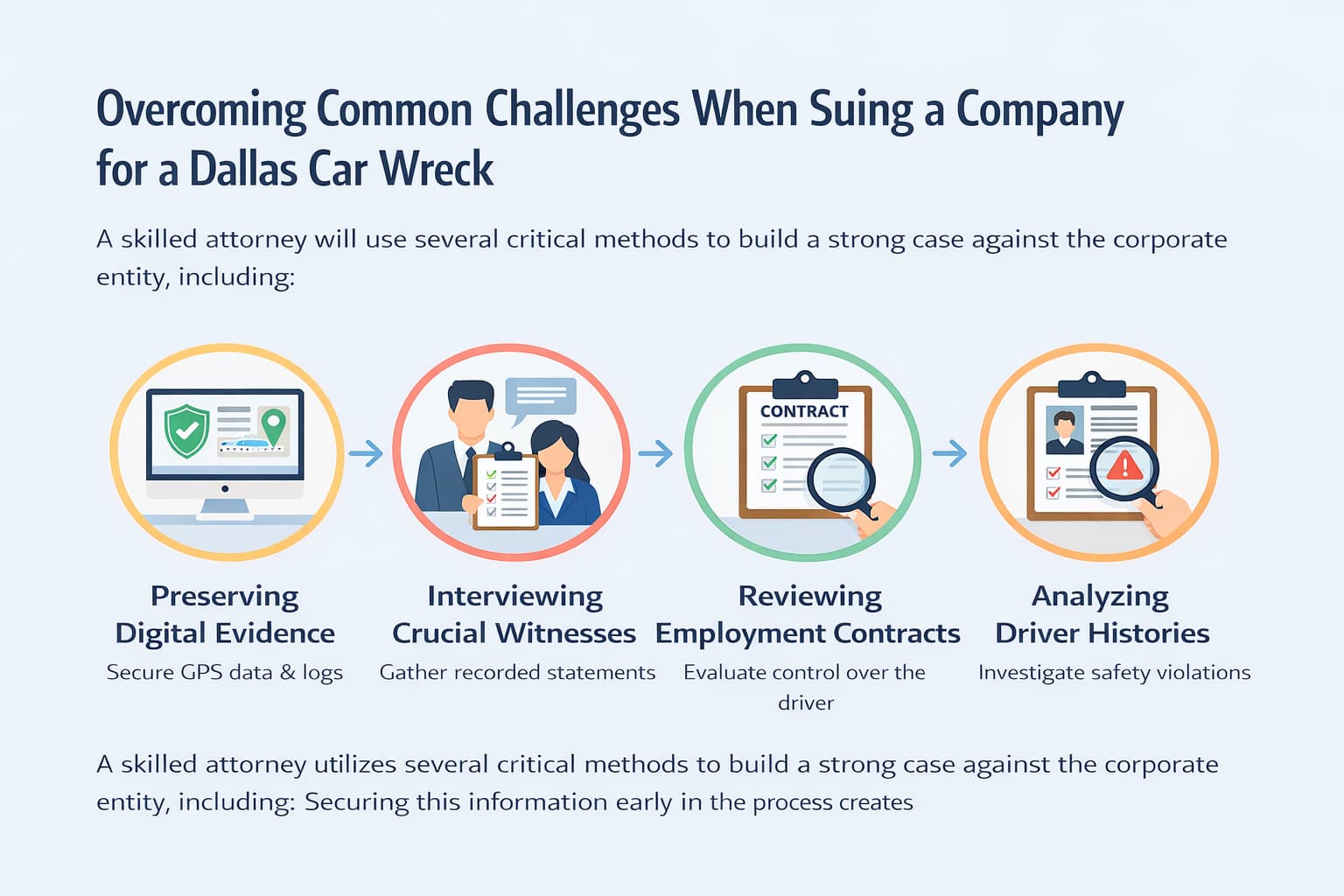
A skilled attorney utilizes several critical methods to build a strong case against the corporate entity, including:
- Preserving Digital Evidence: Formal legal demands can help the company to preserve the driver's specific GPS data and daily tracking logs.
- Interviewing Crucial Witnesses: Recorded statements from coworkers can help show what tasks a manager assigned to the driver on the morning of the collision.
- Reviewing Employment Contracts: Detailed document reviews can show the level of control the company maintains over the worker's daily work duties.
- Analyzing Driver Histories: Background checks uncover past safety violations that can support claims the company hired a worker with a dangerous driving record.
FAQ for Vicarious Liability in Dallas Car Crashes
What Evidence Proves a Driver Acted Within the Scope of Employment?
Proving a driver worked at the time of the crash requires securing daily route logs, GPS tracking data, and company text messages. Your Dallas car crash lawyer also looks at timecards and specific dispatch instructions from the employer. These documents provide a clear timeline of the driver's required tasks for the day.
Connecting these tasks directly to the moment of the crash establishes the necessary legal link to the company.
Can I Sue a Company if an Employee Hit Me in a Personal Car While They Were Working?
You may pursue a claim against a company even if the worker drove a personal vehicle. The core issue revolves around the activity the driver performed, not the name on the vehicle registration. If the driver advanced the employer's business interests, the company shares the blame. A lawyer evaluates the specific work tasks to bring the corporate policy into the claim.
How Do Commercial Auto Policies Differ From Individual Plans?
Commercial policies carry significantly higher coverage limits than standard personal auto policies. Businesses purchase these large umbrella plans to protect their assets from massive liability claims. These policies also involve complex corporate structures and aggressive legal defense teams.
Managing a claim against a commercial policy requires strict adherence to corporate legal procedures.
Does Vicarious Liability Apply to Independent Contractors After a Dallas Car Accident?
The law generally shields companies from the actions of true independent contractors. Companies often misclassify regular workers as contractors to avoid paying for commercial insurance. If the employer controls the specific details of how the driver performs the work, courts treat the driver as an employee.
An attorney investigates the actual working relationship to defeat this common corporate defense.
What Happens if the Employer Denies That the Driver Was Working?
Employers frequently deny that a driver was on the clock at the time of an accident to protect their commercial insurance rates. They might claim the worker ran a personal errand or deviated entirely from the assigned route.
Your Dallas car accident lawyer can counter this defense by securing cellular records and internal emails that prove the employer directed the trip. Presenting strong physical evidence can pressure the company to acknowledge its role in the collision.
Let Experienced Car Crash Injury Lawyers in Dallas Handle the Corporate Battle
Managing a successful legal dispute against a major corporation demands a dedicated advocate. Gathering the right evidence and facing down commercial insurance adjusters requires a deep understanding of corporate law.
At DFW Injury Lawyers, we focus on identifying all available corporate policies to support your recovery. We’ll take on the heavy lifting so you can prioritize your physical healing. Contact our Dallas personal injury lawyer team today for a free consultation.

Kevin L. Edwards
Founder
Attorney Kevin Edwards is a co-founder of DFW Injury lawyers. Over the last 15 years, Mr. Edwards has dedicated his practice to helping those who have been injured or harmed by the negligence, malfeasance, and/or recklessness of others.
Author's Bio