After a truck accident in Texas, you may find out that the truck driver or their company provided a version of events that doesn't match what you remember. Fortunately, there is often an unbiased witness that recorded the final moments before the crash: the truck’s black box.
This powerful piece of technology, formally known as an Event Data Recorder (EDR), can provide a clear, second-by-second account of the truck's actions, which can be vital to your injury claim. Securing this information, however, requires swift and specific legal action, as the data can be lost or destroyed if steps are not taken to preserve it.
Reach out to a Texas truck accident lawyer quickly to preserve and obtain crucial black box (EDR) data before it is lost or destroyed.
Key Takeaways about Getting Black Box Data after a Texas Truck Accident
- Most modern commercial trucks are equipped with an Event Data Recorder (EDR), or "black box," that records crucial data about the truck's operation immediately before and during a crash.
- This EDR data is not stored indefinitely and can be overwritten or erased, making it vital to act quickly after an accident.
- An official legal document called a preservation of evidence letter must be sent to the trucking company to legally obligate them to save the black box data.
- Information from the EDR can be used to establish key facts in a personal injury claim, such as the truck's speed, braking activity, and other driver actions.
- Obtaining and interpreting this complex data typically requires the assistance of a legal team and technical professionals.
What Is a Truck's "Black Box" and Why Is It So Important?
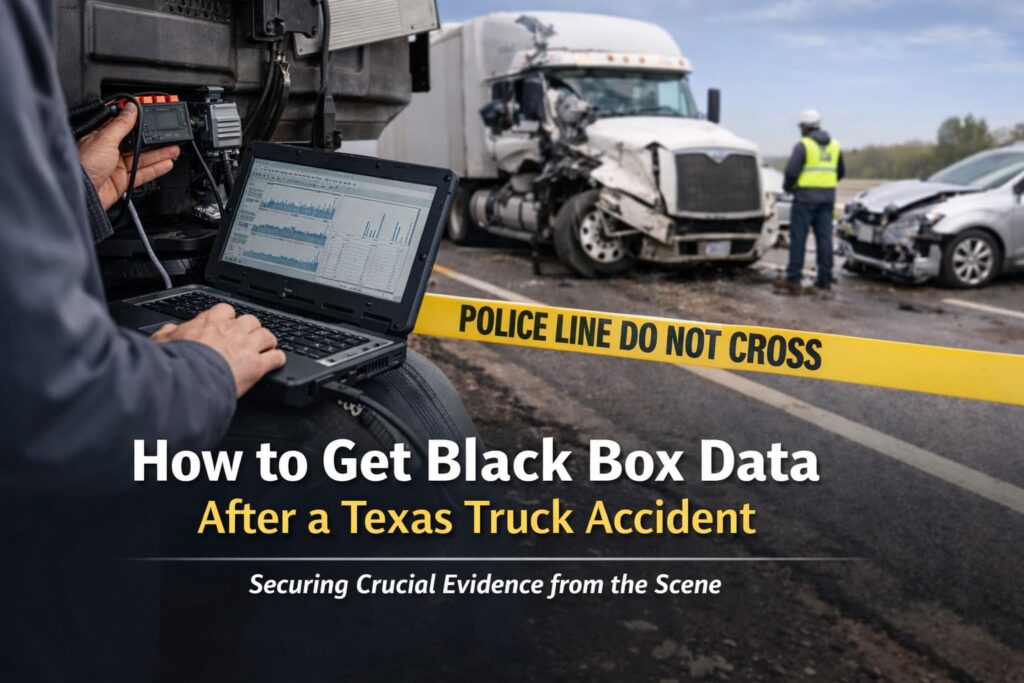
When people hear the term "black box," they often think of the nearly indestructible recorders found on airplanes. Commercial trucks have a similar device called an Event Data Recorder, or EDR. While it isn't required to be crash-proof like an airplane's recorder, it serves a similar purpose: it captures and stores technical vehicle and occupant information for a brief period of time before, during, and after a crash.
Federal regulations outline the data that EDRs must record. This information provides an objective, digital snapshot of what the truck was doing when the collision occurred.
The data captured by an EDR can be incredibly detailed. Depending on the make and model of the truck, the black box can tell you about:
- Vehicle Speed: The EDR logs the truck’s speed in the seconds leading up to impact, which can instantly confirm if the driver was speeding through a construction zone in Fort Worth or on a main road in Arlington.
- Brake Application: The recorder shows whether the driver applied the brakes, when they did so, and with how much force. A lack of braking can suggest a distracted or inattentive driver.
- Throttle Position and RPM: This data indicates if the driver was accelerating at the time of the crash.
- Steering Input: The EDR can record the angle of the steering wheel, showing if the driver attempted to make an evasive maneuver.
- Cruise Control Status: This shows whether the cruise control system was engaged or disengaged before the accident.
- Seat Belt Usage: The system logs whether the driver’s seat belt was fastened at the time of the incident.
This collection of data is invaluable because it is not based on memory or bias. It is a purely factual record that can confirm or contradict the story told by the truck driver. When this data is properly recovered and analyzed, it can become the cornerstone of a personal injury claim by providing powerful evidence of negligence.
The Clock is Ticking: Why You Must Act Quickly
One of the most critical aspects of learning how to get black box data after a Texas truck accident is understanding the urgency involved. This vital evidence is not permanent. Trucking companies are only required to preserve this data for a limited time, and if the truck is repaired and put back on the road, new driving data can be recorded over the data from your accident.
Many trucking companies have their own internal policies for data retention. In some cases, this policy may only require them to hold onto the information for a matter of weeks or months unless they are legally instructed otherwise. Once that period passes, they may erase the data as part of their routine business operations.
This is why you cannot afford to wait. The trucking company and its insurance provider often have a team of investigators and lawyers on the scene within hours of a serious crash. Their goal is to control the narrative and protect their interests. Taking immediate action to preserve the black box data levels the playing field and ensures that the truth of what happened on that road in Garland or Lancaster is not lost forever.
The First Step: Sending a Preservation of Evidence Letter
The most important first step in securing EDR data is to send a formal preservation of evidence letter. This is a legal document, also sometimes called a spoliation letter, that is sent to the trucking company and any other potentially responsible parties. This letter officially notifies them of a pending legal claim and legally requires them to preserve all relevant evidence related to the accident.
Sending this letter puts the company on notice. If they destroy, alter, or allow evidence to be overwritten after receiving the letter, they could face serious legal penalties for what is known as spoliation of evidence. Spoliation is the legal term for the destruction or significant alteration of evidence when litigation is pending or reasonably foreseeable. A judge can impose sanctions on a company that does this, which can include instructing the jury to assume the destroyed evidence would have been unfavorable to the company.
A comprehensive preservation letter prepared by a law firm will demand that the company protect and hold numerous pieces of evidence, including:
- The truck's black box (EDR) and all the data it contains.
- The driver's electronic logs (ELDs), which track their hours of service to check for fatigue.
- Dashcam footage, if the truck was equipped with it.
- The driver's qualification file, training records, and driving history.
- Post-collision drug and alcohol testing results.
- Inspection, maintenance, and repair records for the truck and trailer.
- Dispatch instructions, bills of lading, and any communication between the driver and the company.
This letter is a powerful tool that legally freezes the evidence in place, giving your legal team the time needed to file a lawsuit and formally request access to it.
Who Can Send a Preservation Letter?
While anyone can technically write a letter, a preservation of evidence notice carries legal weight and must be correctly drafted and sent to have its intended effect. This is not a DIY task.
An experienced personal injury attorney knows exactly what language to use, what evidence to request, and who the letter must be sent to (which can include the trucking company, its insurance carrier, and its legal department). An improperly sent or worded letter might be ignored, leaving the evidence vulnerable.
The Legal Process for Getting the Black Box Data
Sending the preservation letter is the action that locks the gate, but you still need the key to open it. The actual process of obtaining the black box data typically happens through the formal legal process after a lawsuit has been filed.
This process, known as discovery, is the phase of a lawsuit where both sides are allowed to request and obtain evidence from one another. Your attorney will use specific legal tools to formally demand the EDR data that was secured by the preservation letter.
Here is a simplified look at the steps involved:
- Filing a Lawsuit: A personal injury lawsuit is filed against the truck driver and the trucking company. This officially begins the legal proceedings.
- Formal Discovery Requests: Your attorney will serve the defendants with a "Request for Production." This is a legal document that demands they produce specific items, including the truck itself for inspection and access to the EDR.
- Scheduling an Inspection: The parties will coordinate a time and place for the data to be downloaded. This is often done at a truck yard or repair facility where the damaged tractor-trailer is being stored.
- Data Download by a Professional: Retrieving the data is a technical job. It requires specialized hardware and software. An independent forensic expert, often agreed upon by both sides, will connect to the truck's electronic control module and download the raw data from the EDR. This ensures the data is not damaged and that the chain of custody is properly maintained.
- Analysis and Interpretation: Once downloaded, the raw data is given to an expert who will analyze it and prepare a report. This report translates the technical information into a clear, understandable format that explains what happened in the moments leading up to the crash.
This process is methodical and designed to ensure that the evidence is handled properly and will be admissible in court.
What Happens if a Trucking Company Refuses to Cooperate?
Even after receiving a preservation letter and a formal discovery request, a trucking company might try to delay or refuse to turn over the black box data. They may claim the truck was totaled and scrapped or that the data is inaccessible.
In these situations, an attorney can take further legal action. They can file a motion to compel with the court. A motion to compel is a formal request asking the judge to issue an order that forces the trucking company to comply with the discovery request.
If the company still refuses or is found to have destroyed the evidence, the judge can issue the sanctions for spoliation mentioned earlier. This accountability ensures that companies cannot simply hide evidence to avoid responsibility.
Analyzing the Data: What the Black Box Can Reveal About a Texas Truck Accident
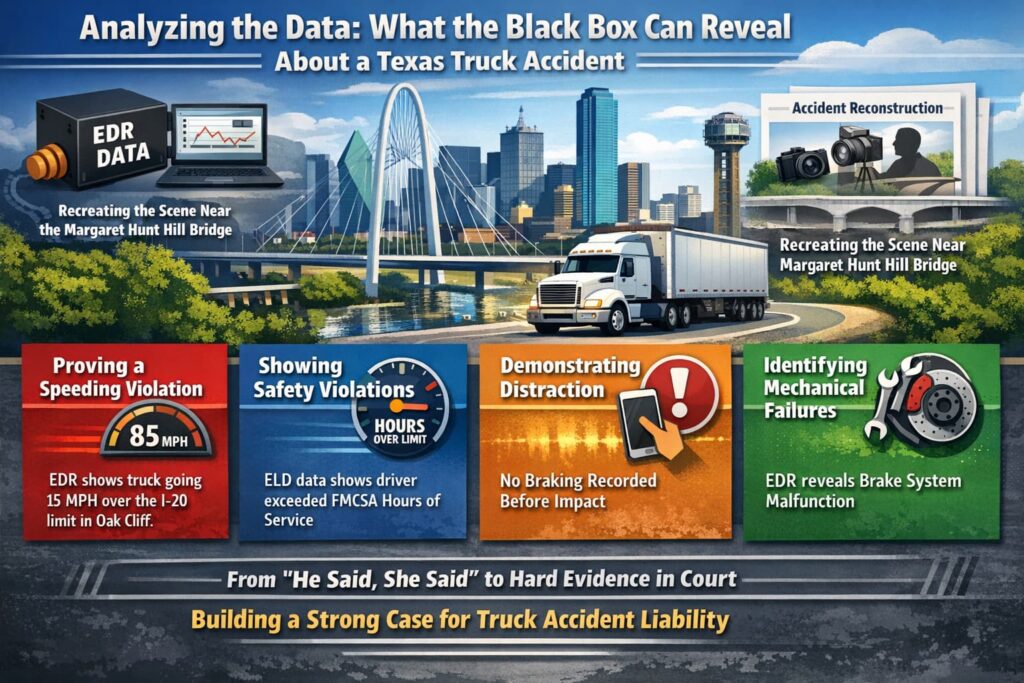
The true power of the EDR data is unlocked when it is used to reconstruct the accident and prove exactly how the truck driver or trucking company was at fault. An accident reconstructionist can use the data, along with police reports, photos of the scene near landmarks like the Margaret Hunt Hill Bridge, and witness statements, to paint a clear picture for a judge and jury.
Here are a few ways black box data can provide the proof needed to build a strong case:
- Proving a Speeding Violation: If a truck driver claims they were driving safely, the EDR can show they were going 15 miles per hour over the speed limit on I-20 through Oak Cliff. This objective data is far more persuasive than a driver's statement.
- Showing Violations of Safety Rules: The Federal Motor Carrier Safety Administration (FMCSA) has strict Hours of Service regulations that limit how long a driver can be on the road without rest. Data from the truck's Electronic Logging Device (ELD), which works with the EDR, can show if a driver was on the road for too long, pointing to driver fatigue as a cause of the crash.
- Demonstrating Inattention or Distraction: The EDR might show a complete lack of braking or any evasive steering maneuvers before a rear-end collision. This strongly suggests the driver was not paying attention to the road ahead, perhaps because they were looking at a phone or were otherwise distracted.
- Identifying Mechanical Failures: In some cases, a driver might claim their brakes failed. The EDR data can show whether the brakes were actually applied. If they were, but the truck didn't slow down as expected, it could point to a maintenance issue, shifting the liability to the trucking company for failing to keep its fleet in safe working order.
This information moves a case from being a "he said, she said" argument into one based on hard facts. This kind of evidence is essential for holding negligent trucking companies accountable and for securing the compensation you need to recover from your injuries.
Truck Accident Black Box Data FAQs
Here are answers to some common questions we hear about this process.
Do all commercial trucks in Texas have black boxes?
While not every single commercial truck on the road has one, federal law has mandated EDRs in most large commercial trucks manufactured in recent years. The vast majority of tractor-trailers involved in serious accidents today are equipped with a device that records crash data.
How long does a trucking company have to keep EDR data?
There is no single federal law that specifies a minimum retention time for EDR data after a crash. This is why sending a preservation of evidence letter is so important. Once a company receives that letter, it is legally obligated to hold onto the data indefinitely until the legal claim is resolved.
Can I get the black box data without filing a lawsuit?
It is highly unlikely. Trucking companies and their insurers are not likely to voluntarily hand over evidence that could be used against them. The formal discovery process within a lawsuit is typically the only way to compel them to provide access to the EDR.
What other evidence is important in a truck accident case besides the EDR?
The EDR is a powerful piece of evidence, but it's just one part of a thorough investigation. Other critical evidence includes driver logs, maintenance records, the driver's personnel file, witness statements, police reports, and photos and videos from the accident scene.
Who pays for the expert needed to download the black box data?
Typically, the personal injury law firm representing the injured person will cover the upfront costs of hiring the forensic expert needed to download and analyze the EDR data. These costs are then usually recovered as part of the settlement or verdict at the end of the case.
Let Our Team Fight to Secure the Evidence You Need
When you are recovering from a serious truck accident, the last thing you should have to do is battle a large trucking corporation for the evidence needed to prove your case. At DFW Injury Lawyers, we bring the muscle to the fight for you. Our team understands the complex federal and state laws that govern the trucking industry, and we know exactly what steps to take to preserve and obtain critical black box data.
We are ready to act immediately on your behalf, sending a comprehensive preservation of evidence letter to ensure no information is lost. From our Dallas office, we serve clients throughout the Metroplex, including Fort Worth, Arlington, Garland, and beyond. Let our dedicated trial lawyers handle the legal battle while you focus on your recovery.
Don’t let crucial evidence disappear. Contact us today for a free legal consultation to discuss your case.

Pedro “Peter” de la Cerda
Founder
Attorney Pedro “Peter” de la Cerda is a co-founder of DFW Injury Lawyers. As a young attorney looking for courtroom experience, Mr. de la Cerda began his career defending physicians, nurses, hospitals, trucking, and manufacturing companies in disputes involving personal injury, medical malpractice, products liability, and toxic tort. After seeing many people who were truly injured and deserving of fair compensation, however, Mr. de la Cerda was moved to cross the courtroom aisle and prosecute cases on behalf of plaintiffs in personal injury cases.
Author's Bio