Navigating the fallout of a serious car wreck in Dallas becomes deeply frustrating when the other driver changes their story. Many modern vehicles contain an Event Data Recorder (EDR) that captures critical crash information, and the EDR data is often the most important piece of evidence.
Recovering from an injury is hard enough without an insurer questioning the facts. Data from a vehicle’s EDR helps establish what actually happened, but obtaining it requires a strict legal and technical process. Insurers often rely on ambiguities to delay or deny claims, making the clarity of electronic evidence from a Texas car crash a powerful tool.
A Dallas car accident lawyer can manage the complex steps required to preserve and retrieve this data. They work with forensic professionals to interpret this information and present a clear sequence of events. A forward-thinking legal team moves your case from a position of uncertainty toward a resolution grounded in undeniable fact.
Key Takeaways for EDR Data and Dallas Car Accidents
- An Event Data Recorder (EDR) captures critical information for the few seconds before, during, and after a collision, including vehicle speed, braking, and other vehicle data.
- Unlike witness testimony, EDR data is objective, scientific evidence that can effectively counter a false narrative from the other driver.
- Preserving this electronic evidence quickly is critical, as a vehicle might be repaired or scrapped, which would destroy the data or make it harder to retrieve.
- This information is often key to proving speed in a car accident case.
- Texas law allows a passenger vehicle’s black box evidence in court, but it requires a proper foundation to show the data is reliable and was gathered correctly.
What Information Does a Vehicle's Black Box Record in a Crash?
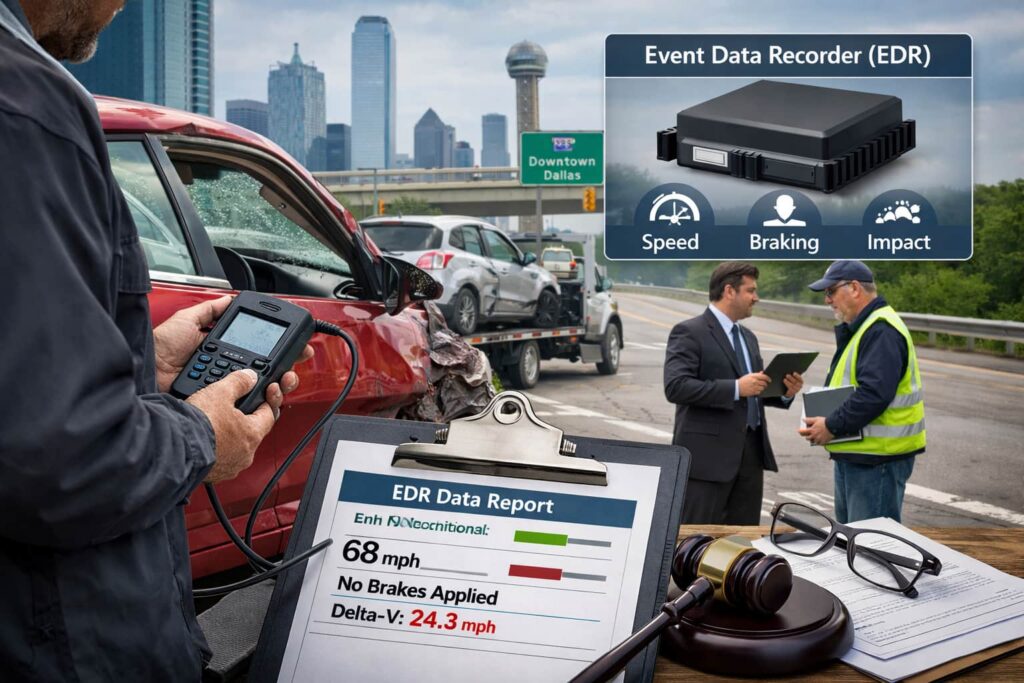
Many drivers are familiar with dashcams, but a far more powerful, silent witness exists in most modern vehicles. The Event Data Recorder, or EDR, is a small device or function that is often part of a vehicle's airbag control module. Sometimes called a black box, it records key performance and operational data in the crucial moments surrounding a crash.
When an airbag deploys, or a sudden change in velocity occurs—like in a high-speed collision on the Dallas North Tollway—the EDR saves a snapshot of information. This isn't a long recording; it’s a capture of seconds immediately preceding the crash and the fraction of a second during it.
The power of this EDR data comes from its objectivity. While a driver might claim they were going the speed limit, the EDR shows the facts. This information is especially valuable in disputed claims arising from crashes on dangerous roads like I-635 or Stemmons Freeway.
Some of the key data points that can be pulled include:
- Vehicle Speed: The recorder tracks speed in the seconds leading up to impact.
- Brake Application: It notes whether the brakes were applied before impact.
- Throttle Position: The data shows how much the driver was pushing the gas pedal.
- Steering Wheel Angle: The EDR may log steering wheel angle.
- Seatbelt Status: It records whether occupants were wearing their seatbelts.
- Delta-V (Change in Velocity): This measures the severity of the crash forces.
Why EDR Data Matters After a Dallas Wreck
In Texas, establishing fault depends on showing that one party’s negligence caused the crash. The EDR data provides a short record of key vehicle data and some driver inputs, which can help demonstrate negligence.
For instance, data showing no brake application before a rear-end collision on a congested street in Uptown Dallas makes it much harder for the at-fault driver to argue that you stopped suddenly for no reason.
This kind of electronic evidence in a Texas car crash case shifts the focus from human memory, which can be flawed, to pure, impartial machine data. The insights help paint a clear picture of what really happened.
How To Get EDR Data From a Passenger Vehicle After a Dallas Car Accident
Retrieving the data from a car's black box isn’t a simple process. The data is owned by the vehicle owner, and accessing it requires specific legal steps, specialized tools, and technical know-how. After a serious collision, the first and most critical action is to prevent the evidence from being destroyed.
Cars involved in significant crashes are often taken to a tow yard or an auto body shop. If the other driver’s vehicle is deemed a total loss, their insurance company might move to have it sent to a salvage yard to be crushed.
Once that happens, any black box evidence may be lost. A Dallas car accident attorney acts quickly to prevent this from happening.
The Critical Importance of a Preservation Letter
The first formal action your legal team takes is sending a spoliation letter to the other driver and their insurance carrier. This is a formal legal notice that instructs them not to alter, repair, or destroy the vehicle. The letter states that the vehicle contains crucial evidence related to a legal claim and that it must be preserved for inspection.
This letter puts the owner and insurer on notice to preserve the car. If the owner or their insurer ignores the notice and allows the car to be destroyed, they may face legal sanctions from the court. This step helps protect your ability to access this silent witness and get the truth about what happened in the seconds before impact.
Working With Forensic Professionals To Download EDR Data
Once the vehicle is preserved, your attorney can coordinate with a professional trained in EDR imaging. They use a device called a Crash Data Retrieval (CDR) tool, which connects directly to the vehicle's diagnostic port or the EDR module itself. This process, known as imaging, downloads the raw data file without changing or deleting it.
A legal professional's involvement is important here. You must be able to prove how the evidence was collected to demonstrate its reliability.
The process of getting this data generally follows these steps:
- Locating the Vehicle: Your attorney identifies where the at-fault driver's car is located, whether it’s at a repair shop in North Dallas or a tow lot in Fort Worth.
- Sending Legal Notice: Your lawyer immediately sends a preservation letter to all relevant parties.
- Coordinating Inspection: Your legal team arranges a time for a forensic professional to access the vehicle, with the owner's permission or by court order.
- Downloading the Data: The trained technician performs the download using CDR tools, creating a documented copy of the crash data.
- Interpreting the Report: The downloaded file is translated into a readable report that your Dallas car crash attorney uses to analyze the collision.
How Does an EDR Prove Speed in a Dallas Car Accident Case?
One of the most common points of disagreement in a car accident case is speed. A driver might say they were traveling at or below the posted limit, while the severity of the crash suggests otherwise. Proving speed in a car accident case without scientific proof is incredibly difficult, often boiling down to one person's word against another's.
This is where EDR information becomes invaluable. The data it provides can break a "he-said, she-said" stalemate with powerful numbers. It replaces guesswork with a precise timeline of the vehicle’s motion before the wreck.
Reconstructing Pre-Impact Actions Second-by-Second
An EDR report presents a pre-crash data table, often showing information in one-second intervals for several seconds before impact. This lets an analyst see important details about what was happening at each moment.
For example, the data might show a vehicle's speed was 85 mph at five seconds before impact, 84 mph at four seconds, 83 mph at three seconds, and so on, with zero brake application.
Contradicting Witness Statements and Police Reports
Police reports provide a valuable overview, but officers usually arrive after the fact. They must rely on witness statements and physical evidence, which might not tell the whole story; a witness may misjudge a car's speed, or a driver may not accurately recall their actions.
EDR data serves as an objective fact-checker. If the at-fault driver told the police they braked hard, but the EDR shows zero brake engagement, this information can completely change the perception of liability. It can reveal inconsistencies that strengthen your case and weaken the other driver's credibility.
Demonstrating Driver Inattention or Reckless Behavior
The combination of data points reveals more than just speed. Imagine a scenario where a car drifted out of its lane and caused a side-swipe collision. The driver might claim they swerved to avoid an obstacle. The EDR data could refute this claim by showing no steering input was recorded while the throttle was fully engaged.
How a Dallas Car Crash Lawyer Leverages EDR Data To Strengthen a Claim
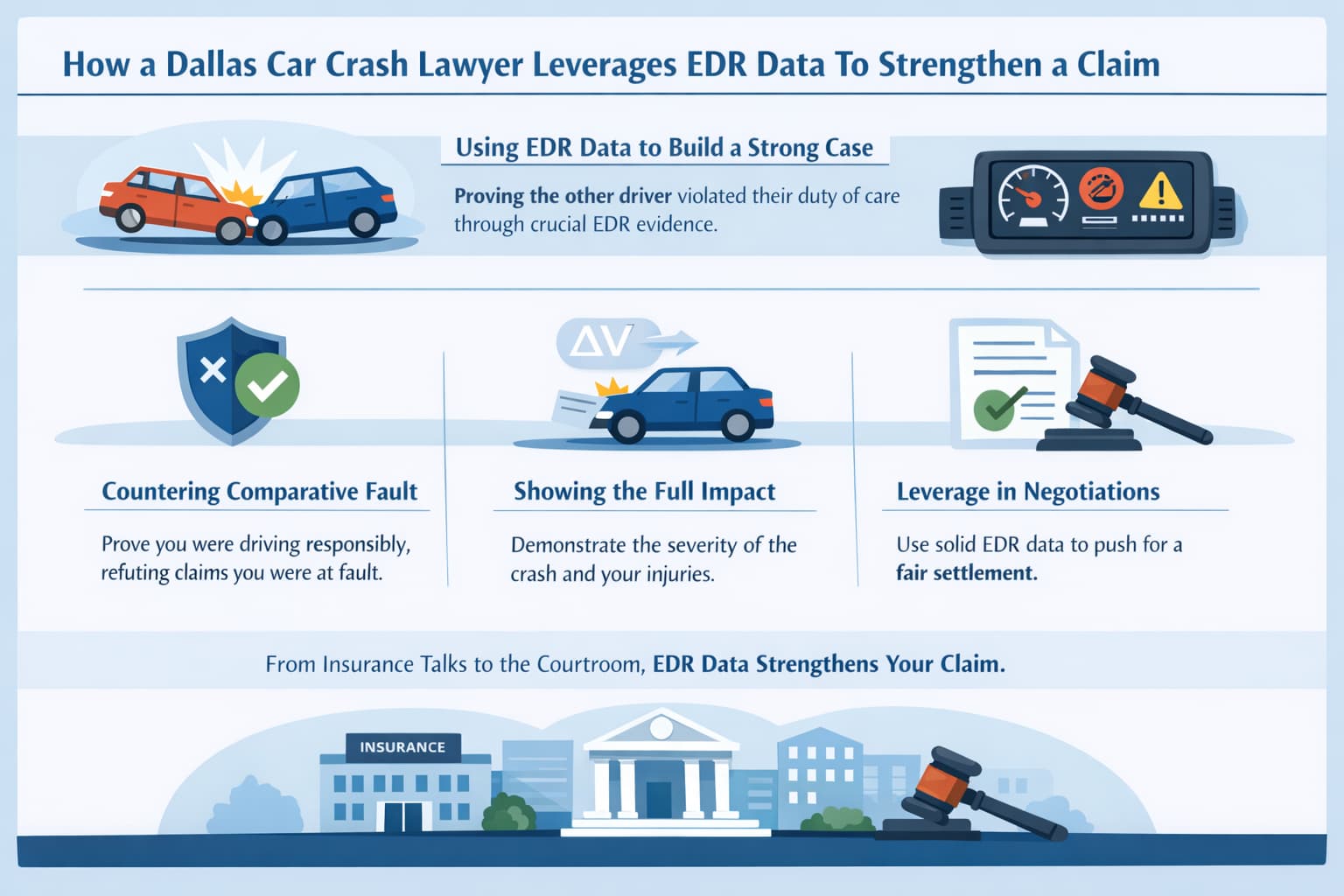
Gathering objective EDR data is only the first part of the process. The next step is using it to build a powerful and persuasive case. The clear, factual nature of this information provides leverage at every stage of a personal injury claim, from initial insurance negotiations all the way to a courtroom. ‘
The primary use is to show how a driver's actions violated their duty of care. Every driver in Texas is expected to operate their vehicle safely. Data proving excessive speed, a failure to brake, or erratic steering serves as strong evidence that the driver failed to meet this standard, making them legally responsible for the harm caused.
Here is how EDR data may benefit your Dallas car accident claim:
- Countering Comparative Fault: The other side's insurance company may try to argue you were partially to blame for the crash to reduce what they have to pay. For example, the insurer might claim you were speeding too. Your car's EDR report could show you were driving responsibly, shutting down this argument.
- Showing the Full Impact: The "Delta-V" measurement shows the change in velocity during the collision. This data can be connected to the severity of your injuries, helping a doctor or medical professional explain why a seemingly minor crash resulted in a serious condition.
- Leverage in Negotiations: When an insurance adjuster faces a scientific report that contradicts their client's story, their position weakens. Presenting strong EDR data often encourages a fair settlement offer because it signals you’re prepared to prove your case at trial.
FAQ for EDR Data and Dallas Car Accidents
What Happens if a Car’s EDR Is Damaged in the Wreck?
In very severe collisions, the EDR module itself can be damaged. However, these devices are built to withstand significant forces and are often housed in a protected part of the vehicle. In many situations, a forensic technician can still recover data from a damaged module.
Can the Other Driver Refuse To Allow Access to Their Vehicle's EDR?
Yes, a vehicle owner can initially refuse you access to their vehicle’s EDR data. In this situation, a Dallas personal injury attorney can file a motion with the court. A judge may grant a court order allowing for an inspection, as the data is considered relevant evidence in a personal injury lawsuit.
Is EDR Data Always Accurate?
EDR systems are widely considered to be highly accurate and reliable. However, the data's admissibility in court requires a proper foundation. This involves showing that the equipment used to retrieve the data was functioning correctly and that the technician followed established protocols.
Does My Own Car's EDR Data Have To Be Shared With the Other Side?
If you file a lawsuit, both sides are generally required to share relevant evidence during a process called discovery. This means that if the other side requests the data from your vehicle's EDR, you’ll likely need to provide it. A Dallas car accident attorney can help manage this process to protect your interests.
Can EDR Data Show if a Driver Was Braking During a Dallas Car Crash?
An EDR records the status of the brake switch, noting whether it’s "on" or "off" in the seconds leading up to a crash. This binary data point can help show if a driver pressed the brake pedal before impact. It’s one of the most powerful pieces of information for determining fault in rear-end collisions.
Let the Facts Speak for Themselves
When you’re facing a disputed Dallas car wreck claim, objective proof is your strongest ally. Event Data Recorders provide a clear, unbiased account of a crash that can cut through confusion and challenge false statements. This powerful information can give you the leverage needed to hold the at-fault driver accountable.
The team of Dallas personal injury lawyers at DFW Injury Lawyers knows how to use cutting-edge technology and evidence to build strong cases for Dallas residents. If you were injured and the other driver isn’t telling the truth, contact us today to learn how we can help.

Pedro “Peter” de la Cerda
Founder
Attorney Pedro “Peter” de la Cerda is a co-founder of DFW Injury Lawyers. As a young attorney looking for courtroom experience, Mr. de la Cerda began his career defending physicians, nurses, hospitals, trucking, and manufacturing companies in disputes involving personal injury, medical malpractice, products liability, and toxic tort. After seeing many people who were truly injured and deserving of fair compensation, however, Mr. de la Cerda was moved to cross the courtroom aisle and prosecute cases on behalf of plaintiffs in personal injury cases.
Author's Bio